
ULRICH IN LOVE
MANS GOT ONE QUALITY: GOATEDNESS

1: AN INTRODUCTION-LIKE BEGINNING CALLED “THE MAN WITHOUT WUT —— ??!”
THE MAN WITHOUT QUALITIES by Robert Musil was always one of them fusty tomes on my should-read periphery;
I was daunted because I didn’t know NOBODY who’d read the book, who’d advocated trudging its difficulties;
— in my hearsay estimation, it was a two volume dull brick of “ideas” : my least favorite thing in the world.
Look at the actual book itself : there’s Musil’s grim hazy face staring at you with a downcast pseudo-smirk as if defiantly cackling to himself,
“READER, YOU ARE GOING TO BE SO BORED!”
Open to the first page : empiricism hits you like a fed-up wife’s frying pan to the back of the head,
“A barometric low hung over the Atlantic. It moved eastward toward a high-pressure area over Russia without as yet showing any inclination to bypass this high in a northerly direction. The isotherms and isotheres were functioning as they should.”
I snapped the book shut as if there was a cockroach in it, — I ain’t listening to your scientific weather report BOB.
But one fateful day, to karmically balance my theft of a more popular book1, I bought the 725-page first volume of The Man Without Qualities and committed to reading the rest of the first paragraph,
“. . . The rising and setting of the sun, the moon the phases of the moon, of Venus, of the rings of Saturn, and many other significant phenomena were in accordance with the forecasts in the astronomical yearbooks. The water vapor in the air was at its maximal state of tension, while the humidity was minimal. In a word that characterizes the facts fairly accurately, even if it is a bit old-fashioned: It was a fine day in August 1913.”
Wait a minute. . .
I looked up at the chapter heading: “FROM WHICH, REMARKABLY ENOUGH, NOTHING DEVELOPS”.
I thought, feeling like I just serendipitously squeezed thru the closing doors of the C train on a weekend at midnight2 : — it’s a . . . JOKE!
THIS BOOK IS FUNNY!
“It can’t be,” I thought, wiping flabbergasm off my face like mistargeted tomato sauce, “Austrian guys weren’t funny in the 1930s. . .”
Reader! Against all odds, this Austrian guy WAS!
I rolled on impetuously like that cheese-wheel they toss down a hill in England for the moronically brave to chase;
I spent the next 20 days reading the 1130 pages of The Man Without Qualities Robert Musil published during his lifetime.3
It’s a project whose incompletability & misapprehension nagged him into penury, disillusionment, exile, & death; eight people attended his funeral in 1942.
IT IS ONE OF THE BEST BOOKS I’VE EVER READ.
2: PHOOEY, OR THE WORLD OF IDEAS
THE BACK BLURB OF MWQ describes it as “a prodigiously fecund novel of ideas” : I can’t imagine a more off-putting way to describe this book.
I struggle to understand what an “idea” is; strugglemorely : what the fuck is a “novel of ideas”, — isn’t that an oxymoron?
A novel is about PEOPLE & LANGUAGE ; the marketplace has stung us like a scorpion filled with myopizing poison, — :
we have allowed our corporate overlords to redefine the novel as a go-ahead plotty meanderless story with a ribbon-wrapped resolution.
Any book that tells you something, or wanders off course is deigned digressive, plotless, a novel of ideas : — quicking at the dictionary, the definition of idea is “a formulated thought or opinion”.
Maybe I am completely batshit insane, but shouldn’t a prose work of several hundred pages be FILLED to the BRIM with formulated thoughts & opinions?
Any “novel” that isn’t should be rolled up like a scroll for its easier & more proper use as toilet paper.
. . . —>
We are killing A LOT of trees for these toilet-paper novels, but like Musil writes,
“stupidity has something uncommonly endearing and natural about it. . .
the truth by comparison, has only one appearance and only one path, and is always at a disadvantage.”
You pick up a recent Recent Prize Winning Novel and are whisked thru page upon page of brisk tedium; you set it down, forget it, move on to the next candy-wrapped confection du jour. It tastes GREAT like everyone says!
Why pick something up that could possibly scramble your sense of U in the World? That will pelt you on every page with SHOCK & AWE?
“This sort of genius has something distinctly ungenial about it, a quality, moreover, that is not even solely its own, so that it is possible to misjudge it in every respect.”
You should just stop reading this now; — fuck Musil; go read Flesh by David Szalay.
. . . —>
THE MAN WITHOUT QUALITIES is a Novel in the purest sense, the only sense that’s mattered since the advent of modern literature, — from whence? Dante?, — :
it’s A CAPACIOUS EXPERIENCE OF LIFE filtered thru a particular consciousness: the more interesting the consciousness, the stronger the work.
But I’m the type of fellow who kant4 learn nothing abstractly, it don’t stick, I need a story;
I can’t tell you the ideological diplomatical dominoes that fell to start World War 1,
but I can tell you Franz Ferdinand suffered greatly for his marriage to his Sophie, choosing LOVE over his children being included in the line of succession;
— a succession sundered by their unfortunate end : Franz & Sophie, dead by two close range bullets, their last communication with their three young children : a telegram to their son, letting him know they’d be home soon to celebrate his good grades. . .
(and this is the Great Event that occurs just off the cliff of this novel; the Great Action everyone is waiting around for). . .
I gotta start with these dots : these human impressions & anecdotes, to build up my geometric skeleton-scaffold of reality.
Musil is a dot-man; the “ideas” are immured in the human character.
3: WHERE AN ATTEMPT IS MADE AT DESCRIBING THE COMPELLING STORY
THE MAN WITHOUT QUALITIES takes place in Vienna, in the year leading up to Franz Ferdinand’s assassination. Ulrich is 32,
“he could not remember any time in his life when he had not been fired with the will to become a great man; it was a desire Ulrich seemed to have been born with.”
He’s tried three times to become Great: he joined the military; tried to be an engineer; then tried mathematics; he succeeded in all three professions, but they left him with a feeling of soullessness.
Now he’s taking a year off of work, trying to decide what he’s gonna do with his life.
And like Hamlet, he thinks too much and don’t DO nothing,
“He would have been prepared to admit that he possessed nothing but a capacity for discovering two sides to everything—the moral ambivalence that characterized almost all his contemporaries and was the disposition of his generation, or, one might even say, its fate. His relation to the world had become pale, shadowy, and negative.
It was caused by the acoustics of emptiness within, where a shot resounds twice as loudly and goes echoing on and on. The Baroque of the Void.”
His head-mired inaction is a hallmark of his generation.
Thru a connection with his cousin, he gets chosen to be a part of the “Parallel Campaign” : a committee that’s deciding on a “Great Idea” to undergird the 70th anniversary of Emperor Franz-Joseph’s reign.
Except they’re planning way too far in advance; the celebration will only be in 1918, and they don’t know it, but by that point, Europe will be in shambles.
So everyone is futzing around bullshitting: live lobsters in a pot on the stove blabbing like they’re out for a spa day, not realizing they’re about to get COOKED.
But really, the novel is about Ulrich and the characters around him playing in LOVE.
Ulrich goes to visit his boyhood friend Walter, who he doesn’t really like anymore,
“each of us would like to shake off the painful sense of having once mistaken himself for the other, so now we perform the mutual service of a pitilessly honest distorting mirror”
and his wife Clarisse who,
“had considered Walter a genius since she was fifteen, because she had always intended to marry only a genius.
She would not let him fail her in this, and when she realized that he was failing she put up a frantic struggle against the suffocating, slow change in the atmosphere of their life. . . she wanted to be the wife of a great man and was wrestling with destiny.”
Walter, a bounce-around dilettante whose real talent was painting, now spends all day at the piano;
Clarisse told him that she won’t fuck him if he plays Wagner, but he can’t resist,
“the music he had once taught Clarisse to despise as the epitome of a philistine, bombastic, degenerate era but to which he was now addicted as to a thickly brewed, hot, benumbing drug.”
By the end of the first volume, Clarisse (who Walter has a pathetically weak grip on) is pulling up on Ulrich, begging him to put a baby in her,
“‘And you say, full of your high scruples, ‘I won’t cheat on a friend,’ but you only say that because you’ve thought a hundred times, ‘I’d like to have Clarisse.’ But just because you’re a devil you have something of a god inside you, Ulo! A great god. The kind who lies to try to keep from being recognized. You do want me. . . .’
She had gripped both his arms now, standing before him with her face lifted up to his, her body curving back like a plant responding to a touch on its petals.”
(I ran that quote long so you could see a hallmark of Musil’s prose : the precision & abundance of numinous metaphor of a medieval manuscript illuminator dolloping ornate figures on every inch of white space.)
Ulrich does not try to put a baby in Clarisse; he receives a telegram that his father is dead as she’s accosting him;
Clarisse hilariously says, “Oh! Congratulations! I suppose you’re going to be very rich now?” and then Ulrich has a feeling,
“He saw a man on various paths, almost painful to look at, left over like a row of puppets that had had their springs broken long ago. One would think that such images are the most transient things in the world, but there are moments when all one’s life splits up into such images, solitary relics along the road of life, as though the road led only away from them and back to them again, as though a man’s fate were obeying not his ideas and his will but these mysterious, half-meaningless pictures.”
He makes a vague resolution to deal with things; and the volume ends with him setting off to the train station;
He’ll head to his childhood home to deal with his father’s estate, and where he has a fateful meeting with his lost sister. . .
4: A SECOND ATTEMPT TO DESCRIBE THE COMPELLING STORY, WITH A FOCUS ON HUMAN SEXUALITY
HAROLD. WHAT IS THE BOOK ABOUT?!
The Man Without Qualities is about LOVE & VIOLENCE!
LOVE is the aesthetic, the imaginative, delusive, irreal experience of existence; a feeling like,
“the power to drive another person into an ecstasy so wild that to be the cause of such changes by any other means one would have to become a murderer.
And truly, that there can be such changes in civilized people, that we actually can produce such effects!—isn’t this the question and the amazement in the bold, glazed eyes of all those who dock at the lonely island of lust, where they are murderer, destiny, and God, and experience the maximum irrationality and adventurousness in the greatest comfort?”
And at one point Ulrich tells his cousin Diotima5, who he has a flirty relationship with (everyone woman in the book is at least interested in fucking Ulrich), that if he ruled the world for the day he would “abolish reality”.
The most impactful moment of Ulrich’s young life is when he was a lieutenant in the military and he fell in love with the major’s wife; it’s told in a chapter called,
THE FORGOTTEN, HIGHLY RELEVANT STORY OF THE MAJOR’S WIFE,
and despite the title telling me how relevant the story was, I discounted it until the end of the first volume when I realized how key it was to understanding how LOVE & VIOLENCE work in this book,
“Ulrich became lovesick. And since true lovesickness is not a desire for possession but the world’s gentle self-unveiling, for the sake of which one willingly renounces possession of the beloved, the lieutenant proceeded to explain the world to the major’s wife in an unaccustomed and persistent manner such as she had never heard before.
Constellations, bacteria, Balzac, and Nietzsche whirled around in a vortex of ideas the point of which, as she sensed with growing clarity, was directed at certain differences—not considered a proper subject of conversation in those days—between her own body and that of the lieutenant.”
What LOVE does is connect YOU to the ONENESS of the world; it is the same aesthetic of Greatness: YOU inseparable from the SOUL of the WORLD;
it is a devoutly wished consummation achieved by Napoleon, Goethe, Homer : — the Megalopsychotic6 Men that these aimless characters keep bringing up as guides.
Everybody in this novel wants to melt & subsume themselves into the REAL at the heart of reality, and Eros is a shortcut to this feeling;
especially in a world collapsing what used to be whole: Empire, Religion, Marriage;
there is no longer safety & fulfillment in institutions; there’s a reason the Parallel Campaign is trying to find a single Great Idea to be the foundation for everything : the condition of this world is that it is missing a core; life is missing a center :
Ulrich & his contemporaries probably couldn’t see this in 1913, but Musil saw it clear-eyed writing with hindsight, writing about the condition of his recollapsing world:
(a fractified, rutterless, emptiness that feels uniquely relevant to the United States in 2025. . .)
But when the erotic is consummated; like when the major’s wife and Ulrich hold hands and,
“In the next second, flames ran through them from their wrists to their knees and a bolt of lightning felled both of them so that they almost tumbled by the wayside, where they found themselves sitting on the moss, wildly kissing and then overcome with embarrassment, because love was so great and out of the ordinary that, to their surprise, they could find nothing to say or do other than what people usually do in such embraces.”
That is VIOLENCE; the boundaries of reality shaping & walling the boundless feeling,
— there is no outlet to their LOVE but the conventional method: kissing, etc., — for a moment Eros made you feel like Goethe, but really, you’re just like everyone else.
VIOLENCE is ethics; our real living that circumscribes our imagination,
“Morality, like every other form of order, arises through force and violence. . . what you get in the end is an infinite network that seems to span everything as independently as God’s firmament.”
Which is why sex is such a big part of this novel: it’s where the fanciful swelling music at the pit of our heart encounters the mottled gooseflesh of substance.
The best example of this is Ulrich & Gerda’s relationship.
Gerda is the twenty-three year old daughter of a Jewish banker, Leo Fischel, who keeps inviting Ulrich over to help control his rebellious daughter;
she’s recently started dating a German nationalist, Hans, who makes anti-semitic speeches in her house, with no regard to her poor father,
(this book is diagnostic of what leads to the rise of the Nazis; — Nazism was a replacement for the void which gives one the mystical & phony impression they are connected to the REAL, that they’re participating in Greatness7: — ),
and Gerda has a crush on Ulrich
(Ulrich gotta be the hunk of hunks, the way these women fall over themselves for him; Musil must’ve thought himself quite the lothario: maybe he was! bro was syphilitic)
who used to be her tutor:
“When Gerda saw him walking through the door, two circular spots appeared on her cheeks, but she energetically shook his hand. She was one of those charmingly purposeful young women of our time who would instantly become bus drivers if some higher purpose called for it.”
Ulrich tells her to pay a visit to his house and at the end of volume one, she does;
as soon as she takes her clothes off, she begins to feel an absolute panic, despite the fact that she,
“imagined that to touch his real self would make her melt like a fragment of snow on a warm hand—but it would have to be the Ulrich she knew, dressed as usual, as he appeared in the familiar setting of her parental home, not this naked stranger whose hostility she sensed and who did not take her sacrifice seriously even as he gave her no time to think about what she was doing—Gerda suddenly heard herself screaming.”
Her body reacts to her revoked consent by uttering a scream!
LOVE meets VIOLENCE in a clear, blunt way; her imagination was so much better than this reality.
Thankfully, Ulrich fights “off a temptation to grab an armful of pillows to press on her mouth and choke off these shrieks that wouldn’t stop.” And Gerda gets away undefiled.
5: TWO DISTASTEFUL TOPICS ELUCIDATED
UHM. . . ULRICH MEETS HIS FORGOTTEN SISTER AGATHE. . .
If you’ve learned anything about Ulrich and the women in this book you can guess what happens: they fall in LOVE.
The first distasteful topic: incest, being broached, let’s layer it with the second : MWQ is an intensely autofictional work.
BRUH. WUT. Musil was in love with his sister?!
NO!
He transforms his real life wife Martha into Agathe to accentuate a point about mystical union8 being a substitute for having no qualities.
Martha & Agathe have the same romantic history: they both married a young man they loved but were widowed early; then married a boring second dude Musil/Ulrich helped metaphorically defenestrate.
His diaries provide clarity for why he would do this; first of all, he saw in Martha a complete dissolution of self into the other:
“Martha. . . isn’t anything I have gained or achieved; she is something that I have become and that has become ‘I’.”
Before Musil was born, his mother9 gave birth to a daughter who died; this lost sister haunted him thru-out his life,
“Elsa my sister was the object of a cult of mine. I sometimes used to wonder what it would be like if she were still alive.”
The first time Ulrich meets Agathe is in their childhood home where their father is dead; it’s night; Ulrich comes out in his pajamas,
“The loose lounging suit of soft wool he put on was patterned in black and gray squares, almost a Pierrot costume, gathered at the waist, wrists, and ankles. . . when he entered the room where his sister was waiting, he was amazed at his costume, for by some mysterious directive of chance he found his appearance echoed in that of a tall, blond Pierrot in a pattern of delicate gray and rust stripes and lozenges, who at first glance looked quite like himself.
‘I had no idea we were twins!’ Agathe said, her face lighting up with a smile.”
Ulrich is a VOID; he is, of course, — the man without qualities;
the perfect thing to fulfill his yearning for pure consummation is someone EXACTLY like him but his opposite:
“Ulrich suddenly remembered as clearly as if the circular image in the field of a telescope were trained across the years on that evening when Agathe was dressed up for a children’s party. She wore a velvet dress, and her hair flowed over it like waves of bright velvet so that the sight of her, even though he was himself encased in a terrifying knight’s costume, suddenly filled him. . . with the longing to be a girl.”
That longing to be a girl is another response to his incompleteness.
Agathe is Ulrich’s perfect partner because society’s VIOLENCE (the facts of existence) outlaws their possibility of a physical relationship: so they can LOVE each other in pure potentiality, pure imagination & delusion.
Their relationship will never devolve into life’s petty trivialities: the commonplace violence of a relationship;
like one night, when Diotima, — who is caught up in a unconsummated dreamy affair10, — is in bed with her husband Tuzzi and,
“Something like the sound of very distant weeping aroused him from his sleep. . . Diotima’s face hovered above him as a painfully bright distortion he could make no sense of. ‘Whatsamatter?’ he muttered in the soft bass of returning unconsciousness, and received a clear, unwelcome answer that stamped itself on his ear, fell into his drowsiness, and lay there like a sparkling coin in the water.
‘You toss about so much in your sleep, no one can sleep next to you!’ . . .
He merely felt that he was the victim of a grave injustice.”
This is the kind of violence that unacceptably knocks the Great Man from his perch; meanwhile, Agathe allows Ulrich flights of high-minded fancy,
“he focused all his attention on the feelings of tender care and adoration of which he had been capable. . . and it seemed to him that feeling of trust and affection, or living for another person, must be a happiness that could move one to tears, as lovely as the lambent sinking of day into the peace of evening. . .”
But their LOVE-SICKNESS is another withered response to the void; there’s no fullness; they are like unaware chihuahuas in the falcon-talons of the collapsing empire; — the Hapsburg Empire that was built on incest!
Ulrich & Agathe’s bubble is a maelstrom of confusion; they are in a fantasyland of pure aesthetics, which, — like a dumbass rich kid’s whirling invention-blueprints11: —is doomed because impossible when brought into contact with reality.
They diagnose the true state of their affairs perfectly,
“‘So we’re leaving it that I’m morally retarded?’ Agathe asked with a forced attempt at humor. . .
‘We’re both morally retarded!’ Ulrich gallantly assured her. ‘Both of us!’”
6: MOOSBRUGGER; SOULSEARCH IN RESPONSE TO THE VOID
WHAT DOES VIOLENCE LOOK LIKE WITHOUT LOVE?
The pure ETHICAL act without any AESTHETIC imagination;
I ain’t putting a good/bad valence on ethical: the dualism here can be reduced even further : a dichotomy of ACTION & INACTION.
There is a murderer who looms large in the imagination of all the characters,
“Moosbrugger was a carpenter, a big man with broad shoulders and no excess fat on him, a head of hair like brown lamb’s wool, and good-natured strong paws. . . a face blessed by God with every sign of goodness. . . Moosbrugger had killed a woman, a prostitute of the lowest type, in a horrifying manner.”
Note that Moosbrugger is a carpenter with a face of goodness; the lamb’s wool hair: — the associations are with Jesus Christ;
but obviously, in Ulrich’s Vienna, Christ’s death & resurrection are not salient facts,
“Salvation, after all, means the same thing as making one whole. . . Saviors may be wrong, but they make us whole again!”
God, Christ, the truth of Catholicism, — the foundation of the Hapsburg Empire for hundreds of years, — fill your cup with LOVE & VIOLENCE;
a perfect combo of AESTHETICS & ETHICS that make you feel like a participant in GREATNESS, and more importantly: gives you a SOUL; everyone is trying to find a substitute for that feeling:
it’s no wonder Ulrich & Clarisse, — the characters most interested in GREATNESS & GENIUS, — are completely obsessed with Moosbrugger, with saving him.
Clarisse sees him as an option. Walter is incapable of writing Faust, Ulrich won’t put a baby in her: these men don’t DO ANYTHING; Moosbrugger DID something!
Finally, after clamoring assiduously12 to meet the ersatz Great Man, she, Ulrich, & the hilariously bumbling General Stumm, — who says to Ulrich about Clarisse,
“There’s something odd about your lady friend. She lectured me the whole way about what will is. I didn’t understand a word!”
— pay a visit to the lunatic asylum. Clarisse is buzzing, frothing in recognition. She sees an insane dude painting and thinks, “that’s the way Walter should be painting!” She is deeply enamored by this Hell,
“it is precisely the bare idea of an unimaginable and therefore inescapable everlasting punishment and agony, the premise of an inexorable change for the worse, impervious to any attempt to reverse it, that has the fascination of an abyss.”
Clarisse is fascinated by Moosbrugger, — VIOLENCE without LOVE, — because it at least feels like something.
We’ve been waiting for most of the book to see what Clarisse is going to do when she’s face to face with Moosbrugger, but of course, it’s not to be.
Their guide gets called for some urgent business and they have to leave,
“Clarisse, however, had such a disappointed, stricken face that Friedenthal proposed to make up the visit to Moosbrugger. . .”
But we’ll never see it.
The General Stumm von Bordwehr, — who is depicted like a fool the whole book, but the idea he wants to propose to the Parallel Campaign is arming the military, the only idea that will make any sense when the war breaks out, —
says something very sensible on the way out,
“Terrible thing, to be out of one’s mind like that. Come to think of it, all the time we were there I didn’t see a single one of them having a smoke! People don’t realize how well off they are as long as they’re still in their right mind!”
The characters we find most interesting in The Man Without Qualities are trying to transcend their reality;
break thru the ethical boundaries of the world thru the force of their aesthetics; but the answer might be, rather than trying to circumvent/unaccept/destroy the ethical, trying to infuse it with our aesthetic imagination.
For General Stumm, that’s as simple as spicing up his sanity with a smoke, — but maybe there’s a grander way to do so. . .
7: IN WHICH THE MAN WITHOUT QUALITIES IS GIVEN A PURPOSE
WHAT, ASSHOLE? AM I SUPPOSED TO FIND JESUS?
I don’t know. . . that’s one of the things about submitting yourself to a tome like The Man Without Qualities : it scrambles your conception of reality; unmoors you, you gotta learn to think & rethink your way out of it.
You are a castaway floating in Musil’s magnanimous ocean; but ain’t no storms, he don’t wanna drown you:
You’re out in the all-alone deep, peacefully, learningly but
U MUST FIND UR WAY TO SHORE.
At the end of the first volume, Ulrich re-enacts Moosbrugger’s route, — out in the boonies, getting solicited by hookers, — that ended in murder;
a young woman approaches him,
“Ulrich found it touching somehow. He did not brush her off but stopped and let her repeat her offer, as though he had not understood. Here he had unexpectedly found a friend who, for a slight charge, would put herself entirely at his disposal, ready to do her best to please him and avoid anything to put him off. . .
he could not bring himself altogether to disappoint the little person who was waiting for him to strike a deal; he even realized that he wanted her to like him, but clumsily enough, instead of simply exchanging a few words with her in the language of her profession, he fumbled in his pocket, slipped approximately the amount she would have asked into her hand, and walked on.”
Paying the young prostitute without using her is the only thing Ulrich really DOES in the whole book! It is an ethical act fired by his aesthetic imagination!
There is a similar, enlightening moment with Agathe . . . :
After her husband Hagauer sends her a letter basically asking her what the hell she’s doing leaving him to shack up with her brother and the VIOLENCE of his intrusion on their delusion-nest makes her want to kill herself;
a stranger comes up to her, sees her in her despondent despair, and opines:
“You are probably still too young to know how simple life is. It only becomes hopelessly confused when one is thinking of oneself; but as soon as one stops thinking of oneself and asks oneself how to help someone else, it’s quite simple!
It’s a modern superstition to overestimate the personal. There’s so much talk today about cultivating one’s personality, living one’s life to the fullest, and affirming life. But all this fuzzy and ambiguous verbiage only betrays the user’s need to befog the real meaning of this protest. What exactly, is to be affirmed?
What’s to be lived to the full? The mind or the instincts? Every passing whim or one’s character? Selfishness or love?
If our higher nature is to fulfill itself, the lower must learn renunciation and obedience!”
This stranger is the first person in the entire book to not think of people as accessories to their own fulfillment & greatness;
the LOVE he is speaking of is very different than what we’ve been talking about;
this is love as self-sacrifice & charity: the famous agape that means caring for another person as a fellow participant in eternity; it presupposes the existence of a SOUL. . .
Oh God, we’re talking about Jesus-ian Love! FUCK! That can’t be the answer!
One would think that Agathe would run to Ulrich to tell him that she discovered the Great Idea for the Parallel Campaign; but of course, she doesn’t.
Nobody wants to listen to some preachy stranger.
There is no ending to this book; no ending would make any sense;
but one does get the impression that the answer to all of Ulrich’s problems is to write The Man Without Qualities:
an act of LOVE in its all-caps glory: the never-ending book, the perfect aesthetic fantasy that earned Musil posthumous GREATNESS; —
and the book that exists : a gift for U & ME : lowercase love, the humble act of sacrificing his life to write something we might be able to learn from & appreciate.
I still don’t know what to make of this book.
This is the first part of this essay; I’ll give you the second part in like 20 years.
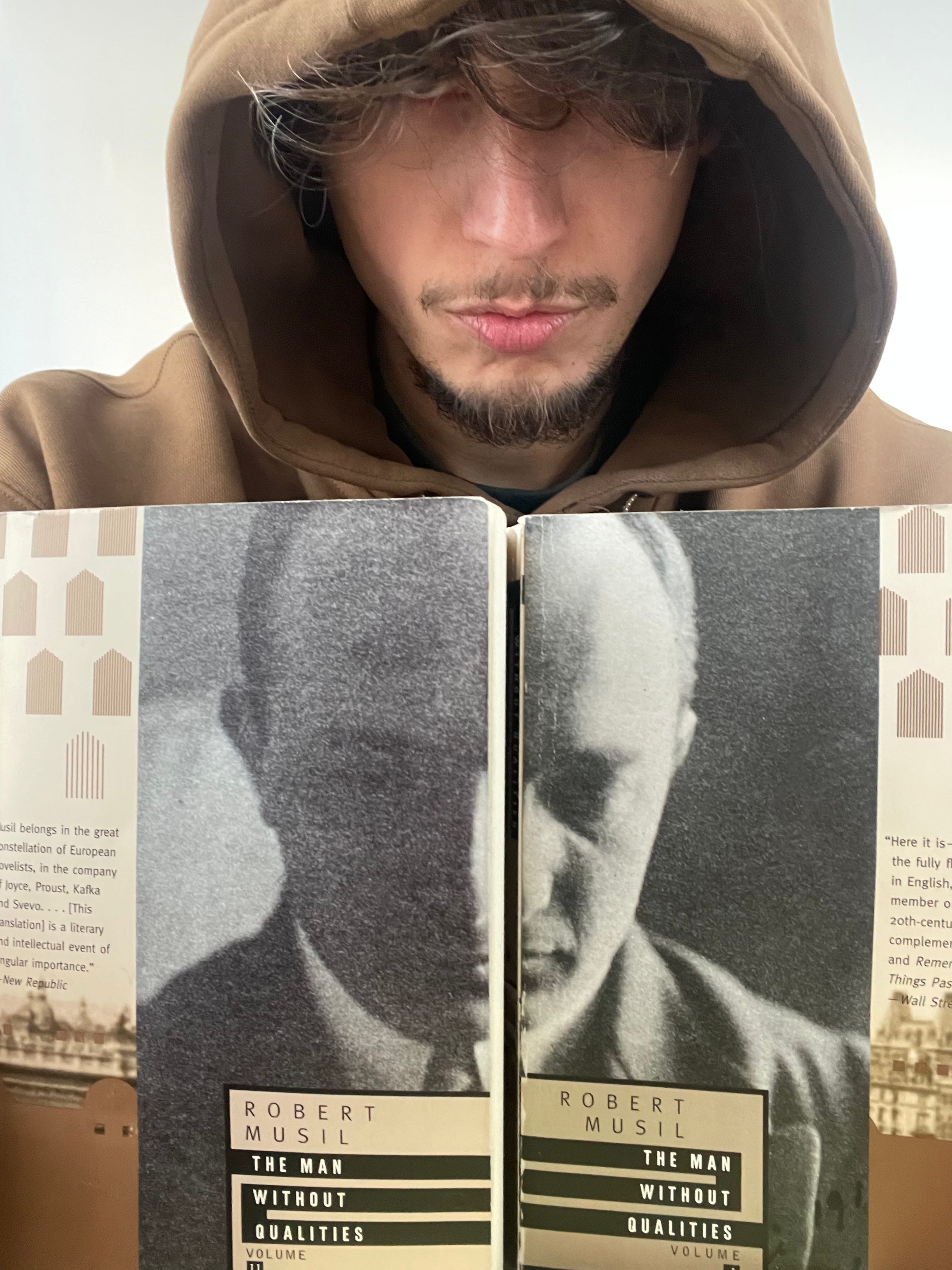
Whoever can guess what book I stole the day I bought MWQ (I recently wrote about it) gets a free subscription to my ANNALS. Hey bookstores! I’d love to purchase books from you but if you don’t carry Tropicália (2023) I’m gonna keep fucking stealing!
Like phew! I almost missed that!
In Sophie Wilkins’s translation into English. The original two parts and 725 pages of the first volume were published in 1930; the 405 pages of the second volume were published in 1933.
Is this a pun? Bruh you Kant take this guy nowhere. . .
Whose real name is Ermelinda but everyone calls her Diotima after the character in Plato’s Symposium who tells Socrates that the point of beauty & eros is to direct one’s mind toward wisdom.
From megalopsychia : Aristotle’s term for “greatness of soul” that is usually translated as magnanimity; my Nietzsche is out of date, but I think Nietzsche revitalized Aristotle’s concept for his ubermensch. Two concepts that are fog in the atmosphere of this book. Nietzsche is very present; Ulrich gives Clarisse a book of Nietzsche’s as a wedding gift (if I was Walter I would think that sus). I think of the LOVE & VIOLENCE dichotomy as a dualism somewhere in between Plato’s world of Ideas and world of appearances; and Aristotle’s ethics of balance. The Great Souled man, after all, for Aristotle, is one who acts automatically for example in the middle of the spectrum between Rashness & Cowardice: he has courage. I feel like I’m losing my thread the further I go into this, but that’s why it’s a footnote, dickhead!
Think of Walter playing Wagner.
Hieros Gamos anyone?! Sean Thor Conroe, I wish I had made this point on the pod: that Agathe and Ulrich are like Venus & the Sun. But I didn’t think about it until after.
Musil definitely had some mom stuff; there’s a great passage in his diaries where he writes about catching a glimpse of her naked when he was 19 and feeling. . . ~admiration~ . . . and growing up, there was a dude who lived in his house with his parents and him; the only role of this houseguest seemed to be to fuck his mom. He had an early view of expansive female sexuality. Ulrich don’t have a relevant mom, but the shadow of his mother lurks behind all the women in the book.
With Paul Arnheim who unfortunately is one character I couldn’t get around to. Arnheim is rich and successful, and like the characters Ulrich scorns, once you get past the satirical gloss you think: maybe this dude has figured this life shit out. Maybe being a windbag sellout hack is much better than being Ulrich! Arnheim and Diotima never consummate their relationship. Instead, in the second volume, she goes deep in the study of sexology (it’s really funny) in order to devote her body completely to her husband.
There is a hilarious story behind this simile, but it’s boxing client gossip, so I’ll tell you in person; I learned my lesson with Melancholy Bob; plus, I think this kid’s dad have me killed if I was talking shit, — and he got the means to do it.
Who tf “clamors assiduously” bro U doin too much !
HAROLD, well done, totally fabulous heartfelt reaction to the book & also totally weird mashup of Musil's mechanically engineered text with the multiple apostrophes of Sterne. It's almost as if Sterne was hanging around in the novel, taking notes (I imagine on a tablet, and also I imagine handwritten, with optional OCR and lots of it all-caps and multiply underlined—something for a future post?).
My own engagement with Musil is different. I'm fascinated in particular by two things.
(1) The fact that it's unfinished, and under this heading especially the moment when Musil may have known that it always would be, or more accurately, the moment the text begins to announce it. If you hadn't known it was unfinished, when would you have sensed it? When would you have started to think about it in every chapter? And — a separate aspect of this question — what does it mean that there are, I think, 11,000 pages in the Nachlass (the notes)? If I'm remembering right, there are only a few texts that address that material in detail. When does incipient form give way to hopeless formlessness? Wittgenstein's Nachlass, which is all online, is something like 16,000 pages (again I'm guessing, from memory): it can be searched, but what would the cumulative effect be, on a reader, of experiencing such enormous wastelands of fragments and repetitions?
(2) I also think of Musil as the exemplar of the "novel-essay." This is a kind of novel that began in the late 19th century. Its hallmark is that the plot is intermittently put on pause while the author has the principal narrator exposit some point — in love, politics, mathematics, hydrology, etc. The principal scholar on this subject is Stefano Ercolino; he has two books on the subject. I'm fascinated by the "novel-essay" as an ongoing problem in the novel. Consider Proust as a contemporaneous example; the narrator permits himself long languorous pauses in the already stilled narrative to explore all sorts of issues. The growth of essays within novels could, in theory, wither the idea of plot in the name of writing that comes from, and basically remains in, nonfiction. Or fast forward to postmodernism: Pynchon is full of "essays," and so is Gaddis, and so is Barth. Gass's essays are like "The Tunnel," and it's like a conglomeration of his essays. I think about this a lot in my writing, and I try to be extreme about it when I do, in order to dramatize the difference between the modes, and not pretend they can be mixed to a uniform gray, which is how I think of Richard Powers.
Of course you're exactly right to think about love and incest, and there's also the despairing criticism of Austrian politics. These are just my own interests.
Omg the twin Pierrot outfits