
TOP 10 ODYSSEY MOMENTS !
OMG HOMER (D'OH) WAS ONTO SMTHG

— 0 .
WHAT MAKES ODYSSEUS SO ATTRACTIVE? —
. . . as rhododaktylic dawn touched the sky this morning I thought of omens & the intolerability of the gods’ inequitable gift-dole. In The Odyssey, if an eagle appears and flies right: triumph portends; flies left: U are FUCKED.
Saturday, on the Times Square subway platform, I saw a man, excruciatingly splayed, in an Argentina jersey, who paramedics were frantically attempting to revive: a sinistral eagle if there ever was one. But if death was looming closely for him anyway, he’s fortunate his heart got him before Spain did. —
Everything goes RIGHT for Odysseus: HUH?
Polytropically cunning, adored by Athena, he spends 20 years away from home, fighting a brutal war, losing all his companions, heaping grief on his heart, but the “many the peoples whose cities he saw, whose ways of thinking he learned, many the toils he suffered at sea,” serve to buttress his legend.
Give him stories to tell: Odysseus’s most vigorous & abiding interest: spinning yarns. His fate is NEVER in doubt. Teiresias prophesies early, after assuring him he will get home safely (without his crew of course. . . so many people around Odysseus die. . .),
“a death far from the sea will come for you, ever so gentle. It will lay you low after you’ve been worn down by rich old age, while around you all your people enjoy their blessings.”
Odysseus is the supreme WINNER: how could we not root for a character who is the smartest, the bravest, the strongest of all mortals? If he, like me, lost his phone in a taxi cab as a divine punishment for preterborrachity, he would surely concoct a scheme to get it back: — the Manhattan streets would flood with the blood of unfortunate cab drivers. . .
Unhelped by Athena, I accepted my fate. Thrust all the spared phone-time into a maiden reading of The Odyssey, — which I always avoided because I thought it was BORING. . . . But it might’ve been a product of Emily Wilson’s translation, which just didn’t hit for me: Homer (d’oh) ought not be so brisk & readable. . .
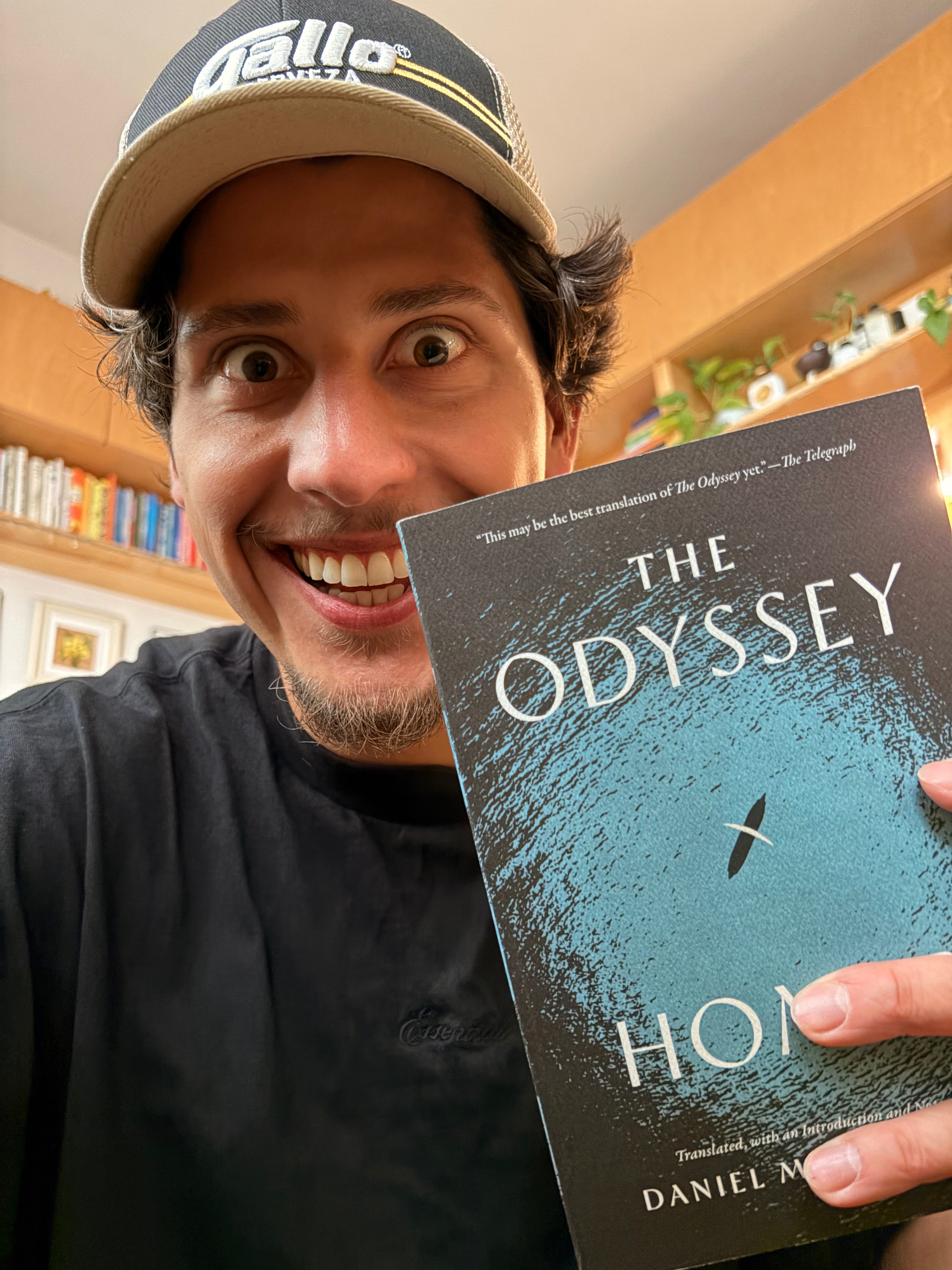
Instead, I read Daniel Mendelsohn’s noble & poetic translation. Ridiculously, I was shocked: the most enduring masterpiece of the Western canon ain’t BORING at all!
Can we still learn anything from Odysseus? Infused by the spirit of click-bait, let’s see if we can find out.
Here are THE TOP 10 ODYSSEUS MOMENTS!
10. ODYSSEUS BOASTS TO THE CYCLOPS
WHO IS ODYSSEUS? —
. . . I am King of a scraggy little island; I am a father; I am a husband: Odysseus clings to these facts about himself; but as each new year piles misfortune like a WALL between U & all U were: how can U cling to Ur identity?
The cyclops is the inciting problem. Polyphemus is powerful, self-legislating: he don’t give a damn about the gods, “since we are much stronger than they are”. Odysseus is stuck in his cave; needs a mighty ruse to escape; especially since Polyphemus is devouring all his succulent mates. . .
Odysseus tells Polyphemus his name is “No-One” : so when he gets blinded & bellows for his companions to come save him, he yells: “Friends, No-One is killing me — by trickery, not force!”
And his dunderheaded fellow Cyclopeses are like, “well if No-One is killing U, leave us alone!”
Odysseus escapes scot-free, but once he is on the ship, despite his crew BEGGING him not to take credit (awful to be sea-fodder for this god-kissed mortal), Odysseus must narrate who he is; he screams,
“if any mortal ever asks about that ugly blinding of your eye, tell him Odysseus, sacker of cities, was the one who blinded it — the son of Laertes, who holds his home in Ithaka.”
Odysseus DELIGHTS in his trickery; but there is more to this curséd boast: he can’t stand to be No-One: he must cite the double-dirt from which he sprung: PLACE & PARENTAGE. . .
9. ODYSSEUS WEEPS UPON HEARING THE BARD
ODYSSEUS IS A VIGOROUS MAN, —
. . . and he fucking cries his eyes dry all the fucking time. This is no modern representation of masculinity: taciturn, emotionally constipated, tortured. No, Odysseus is a free-feeling wreck.
At Local 42, Ethan, Fernándo, & I were tallying up points to see who was the most manly. We asked the bouncer, Rodney, what he thought the most manly quality is, “well. . . ME. I’m a real man. I got seven kids, I’m paying for all of em, I’m divorced, and I’m not on the corner crying about it.”
As much as I would agree that Rodney is extremely manly; maybe feeling all your feelings could be useful for those men trying to emulate a great hero,
“Odysseus dissolved into tears that drenched the cheeks beneath his lids. Just as a woman would weep while embracing a beloved husband who, there before his city and his people, has fallen defending his town and his children from the day that will show no pity —
when she sees him dying there, gasping his final breath, she collapses on top of him, shrieking loudly, while behind her the enemy thrashes her back and her shoulders with their spears, leading her into bondage to endure hard labor and grief, and a heart-wrenching anguish causes her cheeks to waste away — that’s how those wrenching tears streamed from under Odysseus’s brows.”
Odysseus: a woman dragged away to slavery, ululating for her husband! The most profound expression of female grief is the simile Homer (d’oh) chooses to describe his hero’s emotions!
Odysseus’s emotions: deep as the oinopopontic sea. . .
8. ODYSSEUS IS RESCUED BY NAUSIKÁA
WHAT IS THE MOST IMPORTANT PRINCIPLE? —
. . . I didn’t mention the reason Odysseus is crying so hard: he is at a feast given in his honor by the King of the Phaiekians. The bard is telling the story of the Trojan horse: Odysseus’s great trick which is famous wherever there are people. Why does that bring him to tears?
Odysseus has NO seminarian’s conscience. The Trojan Horse doesn’t gnaw away at him: should he have done it? Odysseus DELIGHTS in his cunning. He weeps because he is so moved by the story, and it’s been so long since Troy, since his great triumph; and despite the cinch of his salvation, he’s been suffering, exiled, for a very long time. . .
The daughter of King of the Phaiekians, Nausikáa (she of the beautiful dresses) rescues Odysseus. She sees him creeping in the woods, naked, tattered, covering his shame with a fig-leaf; her friends run-off, but she believes in HOSPITALITY to strangers.
Odysseus flatters her,
“Some time ago, on Delos, I noticed the tender sapling of a palm-tree shooting up right next to Apollo’s altar. When I saw it there, my heart was stunned with astonishment, for no tree quite like it had ever sprung from the earth—the same feeling that strikes me now, my lady, as I marvel at you.”
And thinking of Penelope, gives her a blessing,
“And then may the gods grant you whatever your heart desires: may they grant unto you a husband and a house — and oneness of mind, a worthy gift. For there’s nothing as powerful or as great as when a husband and wife, united by oneness of mind in their thinking, keep their home together — a great bane to their enemies, a blessing to their friends, and their renown is on everyone’s lips.”
The most important thing in this brutal, drifty world (how many of Odysseus’s delectable mates are literally EATEN?) where all harbors might bode doom: HOSPITALITY: knowing because U offered soup & succor to a stranger (who might be a god in disguise) the same spoon might be extended to U. . .
7. ODYSSEUS REJECTS KALYPSO
WOMEN ARE ALWAYS SAVING ODYSSEUS, —
. . . he literally owes EVERYTHING to Athena, — who takes as much joy in wiles as he does (here again is a oneness of mind which Odysseus cites as the greatest pleasure in a marriage); and he finally gets home because Nausikáa gets him to her father’s court,
— where he regales everyone with the stories of his travels: which we never hear directly from Homer (d’oh!), remember: only from Odysseus, who’s been known to tell a lie or two.
After his crew is once-and-for-all-ly WRECKED, he washes up on Kalypso’s island. She takes care of him for seven years. Feeding him, clothing him, banging him; but he’s grown unsatisfied,
“nor did his tears ever dry, since the sweetness of life was trickling away as he grieved for his homecoming. For the nymph had ceased to please him. Night after night he lay down in the hollow caves beside her, compelled by the goddess to do so, he unwilling, she all too willing, while during the day he would sit on the rocks by the edge of the sea, weeping and moaning and tearing his heart to shreds in despair.”
Kalypso wants to make him immortal if he stays with her; Nausikáa wants to make him the eventual King of the Phaiekians if he stays with her; but Odysseus only wants Penelope, and his HOME,
“Divine lady, do not be angry with me, for I know very well how feeble Penelope, that clear-thinking woman, would seem if someone were to compare her beauty or stature with yours. But not a day goes by for me when I am not wishing and longing to be homeward bound and to see the day of my return.”
Don’t know if Penelope would be so thrilled at being called feeble; but I also doubt Odysseus will be reporting back every detail of his voyage, to his beloved wife.
6. ODYSSEUS LIES TO EUMAEUS
ODYSSEUS IS AN EXPERT AT WIELDING TRUTH, —
. . . it’s absolutely remarkable how many people stay utterly devoted to Odysseus; he’s been gone from Ithaka for 20 fucking years! but his name is on everybody’s lips constantly: which is the quintessence of the Hero: U believe, against all the reasonable weight of despair: the hero will WIN.
Eumaios, the swineherd, has succumbed to the classic rancor of the ostensibly hopeless: who rail against the possibility of the thing they hope for most in the world because in their hearts they truly believe it will happen,
“Long before now the dogs and swift birds will have torn the flesh from his bones and his life will have left his body. Or maybe the fish in the sea have eaten him, and his bones are lying out there on the shore, covered by drifts of sand. So he’s perished somewhere out there, a heartache for all his friends, hereafter, but mostly for me, since I shall never again find such a gentle master.”
What makes Odysseus so smart? He is willing to appear WEAK: he is patient to reveal himself; — he only told the Cyclops who he was because he thought that battle was won: he didn’t know the Cyclops would ask his father Poseidon to fuck him over.
Finally on shore in Ithaka, the land he has been desperate to see for 20 years, his HOME! And instead of kissing the dirt, running straight up to the palace, telling Penelope: I’m here! He dresses up as an old beggar, tells his old swineherd some bullshit backstory.
He bides his time, testing loyalty & collecting information,
“May you be as dear to Father Zeus, Eumaios as you are to me — you who freed me from my wandering and awful hardships. There’s nothing more evil for mortals than to be a wanderer. No, men must endure dreadful worries because of their accursed bellies. . . but tell me something of the mother of godlike Odysseus, and the father he left behind, when he went.”
Odysseus knows identity & truth are clay to shape for VICTORY. . .
5. ODYSSEUS IS RECOGNIZED!
OUR HERO CAN’T FOOL EVERYBODY, —
. . . the most surprising moment of the whole book, for me, is when Odysseus is walking up to his palace: he sees his old dog, Argos, lying fetidly on a dung heap,
“Now he lay there, missed by no one since his master had gone away, deep in the dung that was piled high in front of the palace doors — the dung of mules and cattle — so there lay Argos — “Flash” — riddled with vermin.
Though as soon as he sensed that Odysseus was close by, Look! — he wagged his tail and both his ears went flat. But after, he hadn’t the strength to come closer to his master, who looked in the other direction and brushed away a tear. . . and Argos? His fate — black death — took him in its grip the moment he saw Odysseus, after twenty years had passed.”
Of course, Argos is duly representative of the way Odysseus’s subjects SHOULD wait around for their master: utterly loyal, dragging their useless life around until they catch one last glimpse of him; but it’s one of those details, — that even though Vico tells us Homer (d’oh) would be unrecognizably barbarian to us, — bridges the 3,000 year gap, and makes U think the fertile felicity of genius hasn’t changed much. . .
But Argos can’t tell anyone about his master’s return; but Eurykleia, the servant who nursed him when he was a little boy, notices the scar on his foot he had gotten on a boar hunt, decades ago,
“The scar! The old woman had taken his foot in the palm of her hand, and as she probed, she recognized it; all at once both joy and pain took hold of her heart, and her eyes filled up with tears and her voice, so vibrant, caught in her throat: ‘Truly you are Odysseus, dear child — before I did not recognize you, not until I had felt your lordship all over.’”
Certainly, soon, everyone will feel his lordship all over. His response to Eurykleia is a reminder: Odysseus is not only cunning, he is utterly BRUTAL, and he will do whatever it takes to WIN,
“Hold your tongue — no one else in this house must ever find out. Even though you’re my nurse, I won’t spare you when I kill the other serving-women all throughout my halls.”
He can’t enjoy the serenity of a beautiful moment of recognition because the stakes are higher than ever; he’s in the palace, his plan is forming; one can imagine him stifling Argos, if the dog dared bark. . .
4. ODYSSEUS STRINGS THE BOW
THERE ARE 108 SUITORS VYING FOR PENELOPE, —
. . . 108 men plus hangers-on and beggars have been feasting & partying in Odysseus’s house while he’s been away; and he comes crawling amongst them, lowly as a worm, begging for scraps from their plates: if the final victory was uncertain, this level of humiliation would be unbearable, for a reader who has followed him & rooted for him thru every trial.
Can U imagine if one of the suitors killed Odysseus? Every aspect of Western culture might be different. . .
Though Odysseus doesn’t just lay low; immediately, people are apprised that this beggar is a bit different. Another beggar, Íros, makes the stupidest decision of everyone in the epic and challenges the disguised Odysseus to a fight,
“Odysseus hit Íros’s neck just under the ear, smashing in the bones. Right away blood spurted out of his mouth, bright red, and down he fell in the dust, shrieking, champing his teeth, banging the ground with his heels. At that, the lordly Suitors lifted their hands up high, dying with laughter.”
And then Odysseus gives a speech,
“There is nothing more feeble bred by the earth than a human being, for he never thinks he will suffer evil in the future as long as the gods grant success and put some spring in his knees. But as soon as the blessed gods bring dire things to pass, he is forced, unwilling, to bear it with a spirit that must endure.”
I thought about Odysseus as I was walking to Fanatics Fest Saturday, in the most torrential downpour I have ever walked thru. Gaby got tickets from her work, and we thought it would be fun to go. It was NOT fun. By the time we got there, every inch of us was completely soaked; we squished around the Javits Center in grim silence, squeezing our way thru a sports-fanatic sardine tin. The storm made me want to lay in the street and QUIT.
Odysseus NEVER thinks about quitting: his indomitable endurance is completely intoxicating.
By the time Penelope tells the suitors about the challenge to finally win her hand, the Suitors know this beggar, whoever he is, has a dangerous spirit; I always thought they didn’t want to let him try because he was so pathetic: but the truth is, they’re terrified he’ll be able to complete the challenge,
“So with no effort at all, did Odysseus string the great bow. . . It was then that a dreadful anguish came over the suitors: their skin suddenly changed colors. Zeus thundered loudly — his sound!”
He shoots the arrow thru the targets, and then murders every single one of the suitors.
3. ODYSSEUS MEETS ACHILLES IN HELL
BUT WHAT IS ALL THIS KILLING & MAIMING WORTH? —
. . . Odysseus learns everything he needs to learn in Hades; which he gets to solely thanks to Circe, another woman who saved him; what is so remarkable about the Odyssey is that our hero is a singular hero: but the success of his heroism is so inextricable from this web of HELP.
His individual genius is what makes him Odysseus and nobody else; but if he didn’t have any HELP: he would’ve been dead & buried back in Troy. . .
If it wasn’t for the spirit of Agamemnon warning him, he might’ve never concealed himself when he got back to Ithaka,
“This is why even you must never be kind to your wife! When you’re telling some tale you know well, do not reveal everything — no, tell her a part and keep the rest of it hidden. . . my wife did not even let me fill my eyes with the sight of my son. No, she slew me — me! — before I could see him. I shall tell you something else now and be sure to take it to heart: secretly — not in the open — you must bring your ship in to the cherished land of your fathers, since women can never be trusted again.”
Of course, Odysseus’s woman can indeed be trusted. Odysseus & Agamemnon are the starkest doubles in the poem: Agamemnon is supposed to be so tremendously GREAT, but when he gets home from Troy, he is murdered by his wife: two enormous violations (hospitality & wife-loyalty) that never happen to Odysseus.
Odysseus is GREATER than Agamemnon because he is more cunning, and he has chosen the right wife: focused on one-ness of mind as the supreme principle.
But the most remarkable thing that happens in Hades is the appearance of the shade of Achilles; Odysseus greets him happily,
“No one was ever more blessed nor will be so again. Before, while you were alive, we Argives honored you just as we honored the gods, and now you wield great power among the dead here. So don’t let your death cause you grief, Achilles.”
And Achilles, stunningly replies,
“Don’t you sweet-talk me about death, illustrious Odysseus! I would far rather live off the earth as the serf of another man — some man with a pitiful portion who barely ekes out a living — than rule here as lord of all those who are dead and gone.”
There is no glory that can compensate for death. . . and if there’s no glory, — who is more glorious than Achilles? — that can be worth more than any LIFE : glory is worthless. The only thing that matters is securing the HOME, so it can sustain & create more life. . .
2. ODYSSEUS & HIS FATHER & HIS SON JOIN IN BATTLE
THE ODYSSEY IS A FAMILY EPIC, —
. . . poor Telémakhos might be the person who suffers the most in the whole poem; the only father he has ever known is this myth of a father who for some reason, his mother expects to make some fantastical return; 108 men are piling into his house every day to try to fuck his mom and knock him off the potential throne. . . it is NOT a good situation. . .
But the first person Odysseus reveals himself to is Telémakhos; Athena makes him extra beautiful, godlike, and he breaks the news,
“‘I am your father, on whose account you groan and sigh, suffering so much pain, and enduring the violence of men.’ So saying, he kissed his son, while down from his cheeks the tears poured to the ground.”
Telémakhos disbeliefs it for a split second, but then he’s fully convinced,
“Telémakhos twined round his noble father, wailed as the tears poured down; and a desperate longing for weeping welled up in both of them. Bitterly they keened, crying more shrilly than birds — ospreys or bent-clawed vultures whose young some country folk snatched out of the nest before they were fully-fledged: that’s how pitiful were the tears they shed from beneath their brows.”
Telémakhos has become a man, basically overnight. And he very happily helps his father defeat all the suitors, — the only one Odysseus lets in on his plan.
But this book is about FATHERS & SONS, and the final reunion of the book is between Odysseus and his father Laertes, — Laertes, hopeless & grief-stricken, who is working the ground like a slave. Odysseus plays a cruel trick on him, lies about who he is, and tells Laertes he saw Odysseus five years ago,
“A black cloud of grief descended on his father. Using both of his hands, he took fistfuls of dirt, black as soot, and smeared it all over his graying head, heaving with moans. Odysseus’s heart was moved: a spasm of violent emotion flared up in his nostrils as he gazed at his dear father. Rushing at him, he embraced him and kissed him all over, saying: ‘that man you were asking about is right here — I, myself, Father.”
And then the three generations of men band together to fight the fathers of the dead Suitors,
“Laertes rejoiced and spoke this word: ‘What a day this is, dear gods! Truly I rejoice to behold my son and grandson competing to see who is bravest!’”
And they fight, until Athena comes in and shuts the whole battle down; claiming ultimate victory for herself, and of course her cherished mortal: Odysseus.
1 : ODYSSEUS PROVES HIMSELF TO PENELOPE
ONLY PENELOPE CAN MATCH WITS WITH ODYSSEUS, —
. . . nobody is in a more difficult position than Penelope; it is easy to overlook how much cunning it takes to be functionally running a Kingless kingdom (which won’t allow for a Queen) for 20 years! But Odysseus chose excellently, when he chose Penelope.
Why doesn’t Odysseus reveal himself to Penelope? If he needed help with his plan, who better than the smartest mortal woman? But Odysseus knows Penelope won’t believe him. She surely has a hunch, as soon as she sees this strange beggar, that it could be her husband.
If Eurykleia can recognize his body, can’t his wife? — She’s spent the last four years weaving & unweaving a shroud for Laertes,
“While it was still daytime, I would weave the enormous fabric, but I’d undo my work each night by the light of the torches I’d set there. For three full years I fooled the Achaeans, my ruse undetected, but season followed on season and the fourth year came around, the men came and caught me, shouting words of reproach at me. And now I cannot escape this marriage. Nor do I have any other tricks up my sleeves.”
Just as Odysseus weaves & unweaves his tales, Penelope does the same to her shroud. She tells an awful lot to this beggar, this supposed stranger; and stunningly, she decides to set up a contest the very next day: whoever can string the bow only Odysseus had ever been able to use, she will marry them.
But even after Odysseus proves himself fantastically, — literally killing all of the Suitors, — Penelope isn’t convinced. She is too shrewd! She knows in this world, some sly devil could slip in, don Odysseus’s long-forgotten countenance, and fool his way to be king. She’s not like Telémakhos, who would accept any reasonable father at this point. She needs real proof. What would only Odysseus know?
She tells Eurykleia to go make the stranger a bed outside Odysseus’s room; Odysseus freaks out,
“Woman, what you have said deeply pains my heart — who has moved my bed somewhere else? That would be hard for even a man who is skilled — not unless some god were to come and easily, just by willing it, move it somewhere else.”
Odysseus built the room, and his bed, out of an entire olive tree. Penelope’s ruse is brilliant because it simultaneously proves Odysseus is who he says, and it also proves to him that nobody has been in her bed since he’s been gone!
“He wept as he held his wife, heart of his heart, whose thoughts were so true. Just as the sight of land is welcome to swimmers at sea whose well-built ship Poseidon has splintered upon the ocean as it’s driven on ahead by the wind and the surging waves; a few of them have escaped onto land from the iron-gray sea by swimming, the crusts of brine forming around their skin and — welcome sight! — they tread on dry land after escaping from disaster: that’s how welcome the sight of her husband was as she gazed upon him, nor could she bear to let his neck slip from her white arms.”
It is one of the great happy endings in all literature: Odysseus & Penelope’s endurance & intelligence is rewarded; and for now, in Ithaka, HOME is restored. . .
COMMENT UR FAV MOMENT IN THE ODYSSEY & FAV TRANSLATION!
I have read the Portuguese translation by Frederico Lourenço (prose + numbered lines), excellent. There is a detail I never could understand: the poet, Homer (d'oh), addresses many times the swine-herder (?) Eumeus, as if he were the audience: "Foi então, porqueiro Eumeus, que lhe deste esta resposta..." -- and so on. This sounds as if the whole poem were the story told by a guuy to another guy (in Grande Sertão: Veredas fashion).
Odysseus going for Eurykleia's throat, just after the aside about him being nursed from her breast. DAMN. War and hardship's really fucked with this guy.