
MOMA TOP TEN
MY PROVISIONAL RANKING

MY CREDENTIALS
I HAVE NO CREDENTIALS.
The paltry “formal” training I have is from elementary & highschool where art was my worst subject, not in a laissez-faire I-don’t-care way: it was total contentious loathing: I’d declare to my teachers incessantly,
“ART IS BULLSHIT!”
It’s a waste of fucking time, anybody who made art or appreciated it was a dead-beat fucking LOSER.
My relationship with every art teacher was one of mutual abhorrence.
In 5th Grade my art teacher, the pierogi-lusty Ms Wiśniewski, hugged a garbage man1 at recess;
I was laughing independently of what I thought was a very normal situation, but when we got back in class, she stormed in,
steam whistling out of her ears like a duped cartoon character, her visage incarnadine like a deranged tomato:
she pointed right at me and screamed,
“oh it’s HILARIOUS that I hug garbage men, isn’t it?! HA! HA! HA! I’ll tell you what you little SHIT, you’re NEVER gonna make as much money as a garbage man! EVER!”
I said, “OK. . .”
And we pulled out our Elmer’s glue and went to work.
IN HIGH SCHOOL, my teacher was the spaghetti-stimulated Ms. Abantantuono.
She was literally giving me an F in the class because she would show us paintings done by her favorite little student and I would say, “that shit SUCKS!”
And then I would refuse to do my work in protest of such a low standard of rigor that paintings by that dude were being lauded.
I found out at the end of that semester via said dude imprudently boasting & showing off his sexts at the basketball game that she was uninfrequently slurping him up in the Walmart parking lot.
Love & fellatio (given or received) is poison to critical judgement.
We came to no solution. I got a C minus in the class.
I stalk her Instagram sometimes to doom-root & glee-gloat; — she got an honorable mention in the Jefferson County art show a few months ago!
I LIKE VISUAL ART NOW:
(an attritional education borne from LOOKING & ROMPING)
a fact that heartily aghasted my family and was heaped on the pile of evidence of how BigCityLiving & my bewitching cosmopolitan vixen were ruining me.
THRU MY EXTREME dilettante’s eyes I’m gonna rank what I thought were the 10 best works at MoMA (not “the MoMA” dipshit!)2 when I went last Wednesday.3
The criteria being solely my own enthusiasm & intuition.
You’ve been warned: this list is likely chock-full of ignorance & idiocy.
DRUMROLL PLEASE!
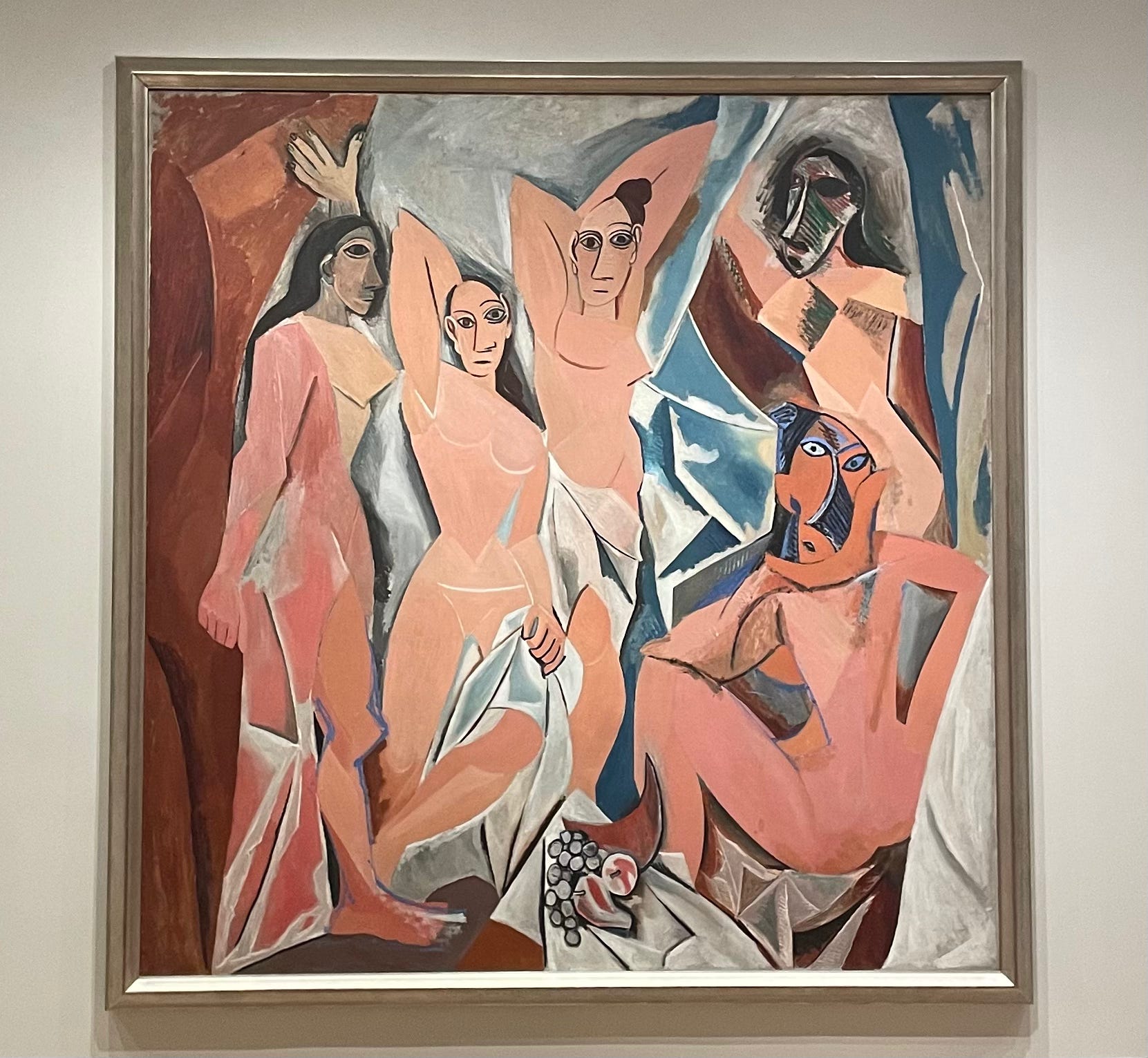
1O. LES DEMOISELLES D’AVIGNON, PICASSO (1907)
WHAT AIN’T ON THE LIST :
The Starry Night (1889) & The Persistence of Memory (1931).
I like Van Gogh, but witnessing the herd of droolers crowd around that painting with their phones in front of their faces smells like a street drenched in insalutary urine: I flee the room with my hand pinching my nose;
plus, when an image has proliferated enough, you can’t extricate it from its giftshop coffin: it’s kitsch. Starry Night works better as a puzzle or a magnet than a painting.
And I feel the same way about Dalí ‘s painting. I admire it in the way I admire the Nike logo; memetic proliferation don’t lie.
Dalí IS a very exciting painter: —> for children.
What does still SHOCK despite its fame is Picasso’s ladies: a painting he called “my brothel”.
You walk thru the AWFUL Cubist room, thinking you’re in a chamber of unpalatable optical illusions;
— if that’s what folks in the early 1910s were making: World War 1 was a mercy like the Biblical Flood, —
and then you see Picasso’s Demoiselles and it ALMOST sucks (the colors are repellant),
but it’s so beastly & blatant & penetrating, the women looking right at you, a perverted twist on Las Meninas (1656);
the figures, masked & unmasked, are so poised & individual you can’t help but admire.
This is what Gertrude Stein writes about Picasso,
“This one was always having something that was coming out of this one that was a solid thing, a charming thing, a lovely thing, a perplexing thing, a disconcerting thing, a simple thing, a clear thing, a complicated thing, an interesting thing, a disturbing thing, a repellant thing, a very pretty thing.”
This painting is all of those things simultaneously; my favorite detail is in the bottom middle: it looks like a still life of a fruit bowl,
but the grapes are coins: fruits of these women’s labor.
9. TONGUES, ARCHIBALD JOHN MOTLY JR. (1929)
I DON’T KNOW NOTHING ABT ARCHIBALD JOHN MOTLY JR.
But he got a sick name, and I loved this painting.
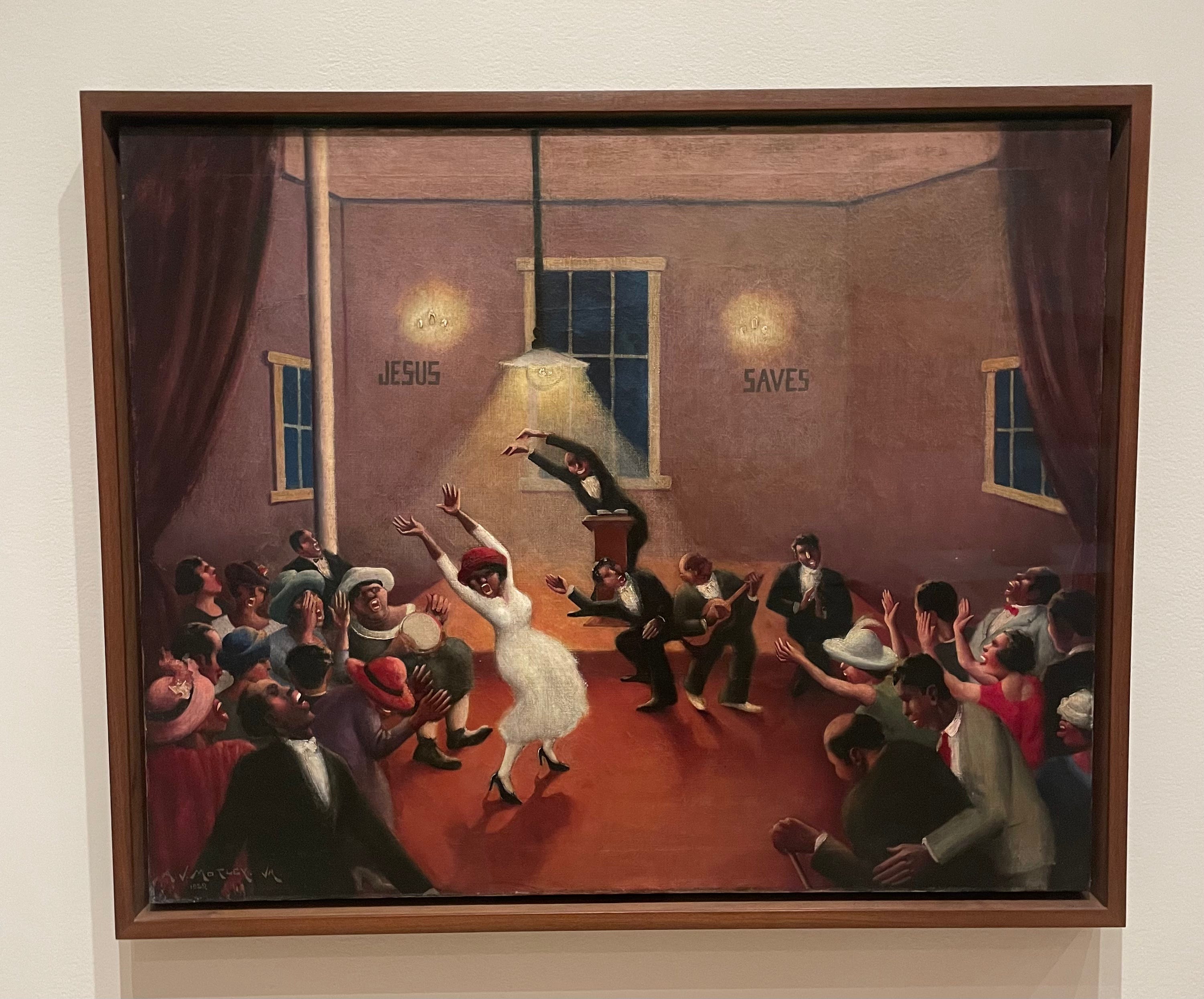
This don’t look like a Catholic mass, but Motly gotta be Catholic because he frames the whole thing around a Trinity:
the three figures with their arms out, under the triangular light of a light-bulb, and in my interpretation it looks like a subordinated Father & Son,
and a strident, powerful Holy Spirit: the woman with the white dress & red hat planted stately on her heels.
This is a scene of pentecostal concord (the title referring to the tongues of fire over the disciples heads in Acts 2) that makes palpable & manifest:
GOD IS IN YOU!
This painting presents a heresy I can totally get behind: the Holy Spirit is actually the supreme member of the trinity:
your participation in GODLINESS is exuberance & frenzy;
the people in this painting have all been SAVED, this is transcendence in motion: humans animating a staid, bare room; everybody
mouths open, screaming, clapping, caught up in the ecstasy of REDEMPTION.
8. EQUAL, RICHARD SERRA (2015)
EQUAL IS THE QUINTESSENCE OF WHAT BUMPKINS EXPECT AT MOMA.
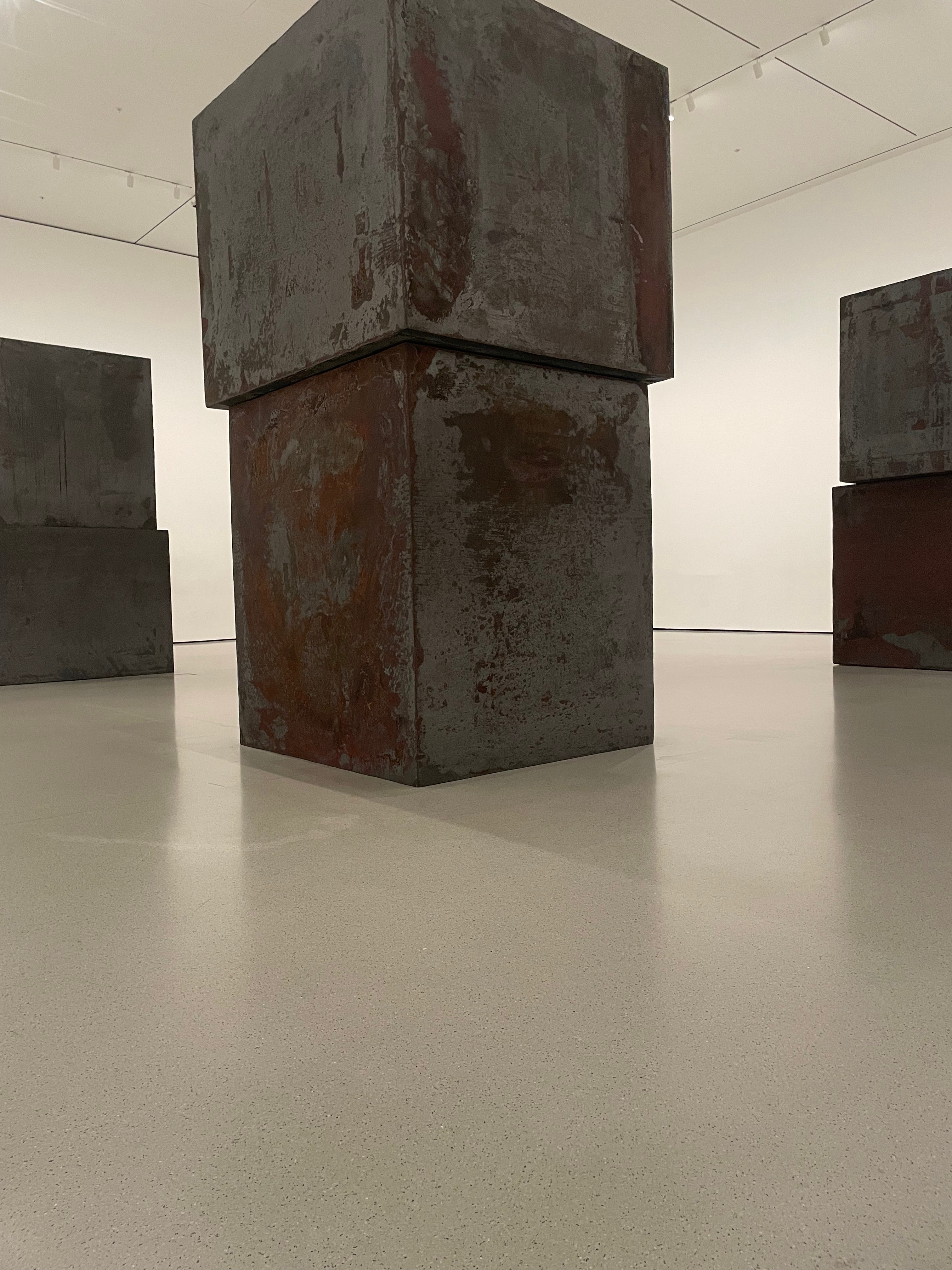
You walk into a big ass room and all you see is enormous steel blocks stacked on top of each other and you think to yourself,
oh this artist thinks he’s SO FKN SMART!
But it occurred to me today that the modernist visual art project was about removing Time from Space: they were after an art of pure Space;
opposed to Literature: modernists were after a Spaceless Time where you didn’t have to waste your reader’s time blabbing I-was-here-ly, She-look-like-this-ly (like in the 19th Century novel) ;
You could get to the JUICE.
Richard Serra’s Big Fucking Blocks (and that’s what I would’ve called this work, but I think Serra wants to emphasize the seriousness of the project) :
is all JUICE; removing the turgid mediations of narrative, time, color: it’s pure Space, in a simple, clear, monumental iteration: at a scale you can’t get with a canvas.
And it’s one of the few art works in the whole museum you can TOUCH!
Eight gigantic steel cubes sitting pretty, stacked in their own room is objectively AWESOME.
7. A LUA, TARSILA DO AMARAL (1928)
TARSILA IS THE MOST IMPORTANT BRASILIAN PAINTER.
Her painting Abaporu (1928) inspired her husband Oswald de Andrade’s Manifesto Antropófago (1928) which kicks off,
“Cannibalism alone unites us. Socially. Economically. Philosophically.”
What they mean by cannibalism is taking what belongs to other cultures and EATING it in order to transmogrify it into something BRASILIAN;
Tarsila studied in Paris, she knew all the trends:
she combined those formal techniques and an idea of Brasilianism connected to a mystical truth she thought was inherent in the land & the Tupis,
“Tupi or not Tupi, that is the question.”
to regurgitate a capacious new representation of modern Brasilian ART.
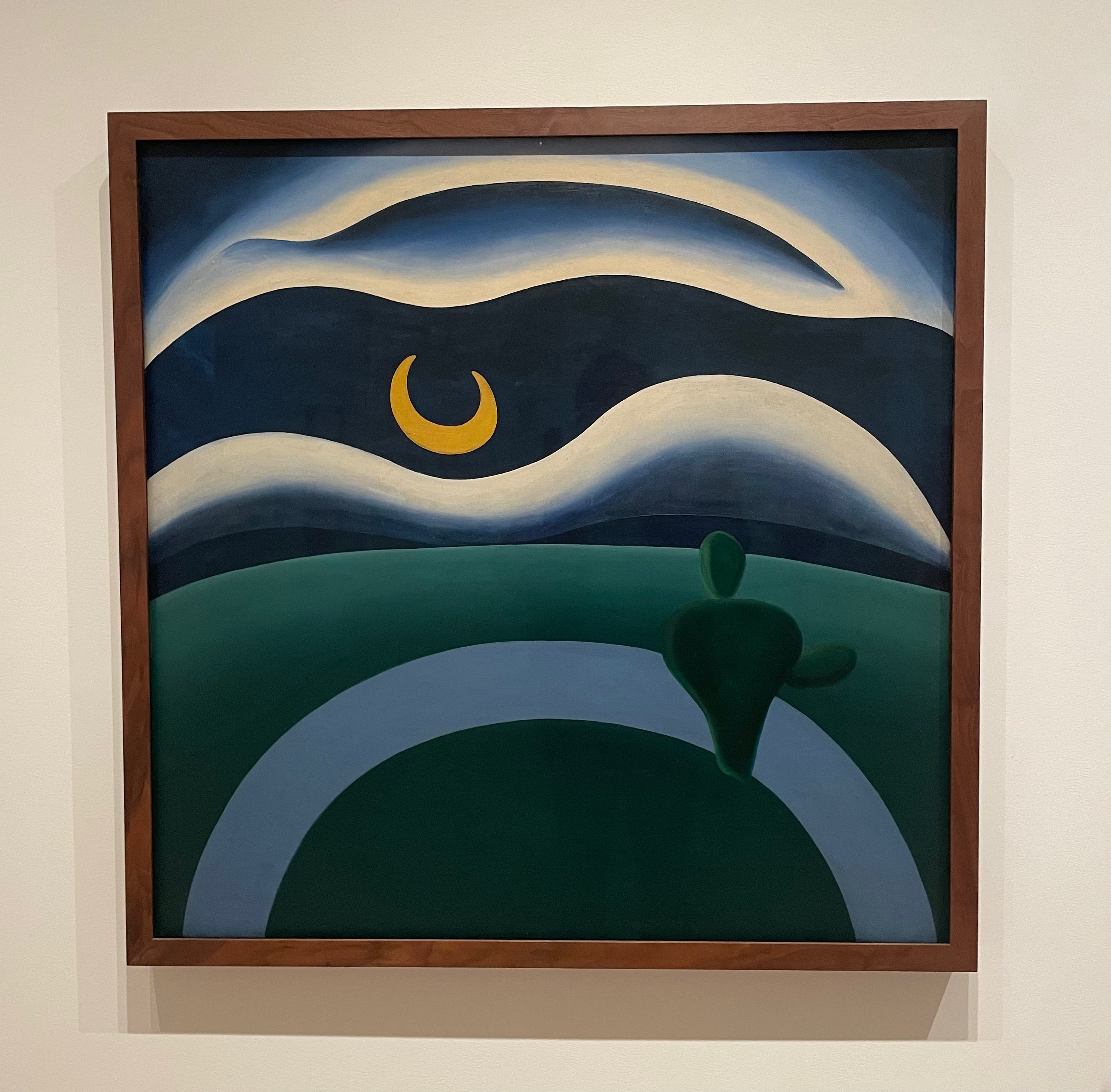
In A Lua, Tarsila turns a nocturnal vision of Brasil’s interior (which she got to know well on a road trip with her modernist crew) into an undulating, glowing dream;
what stands out is the cactus-person, at the edge of the frowning river, — (our real Brasilian : GREEN, one with the land), —
single arm out in louvation, oriented in lunotropic worship toward the smiling flag-YELLOW moon,
(Hieros Gamos, — sacred marriage, — of GREEN & YELLOW),
hung on the distant luminous horizon of what might be Paradise. . .
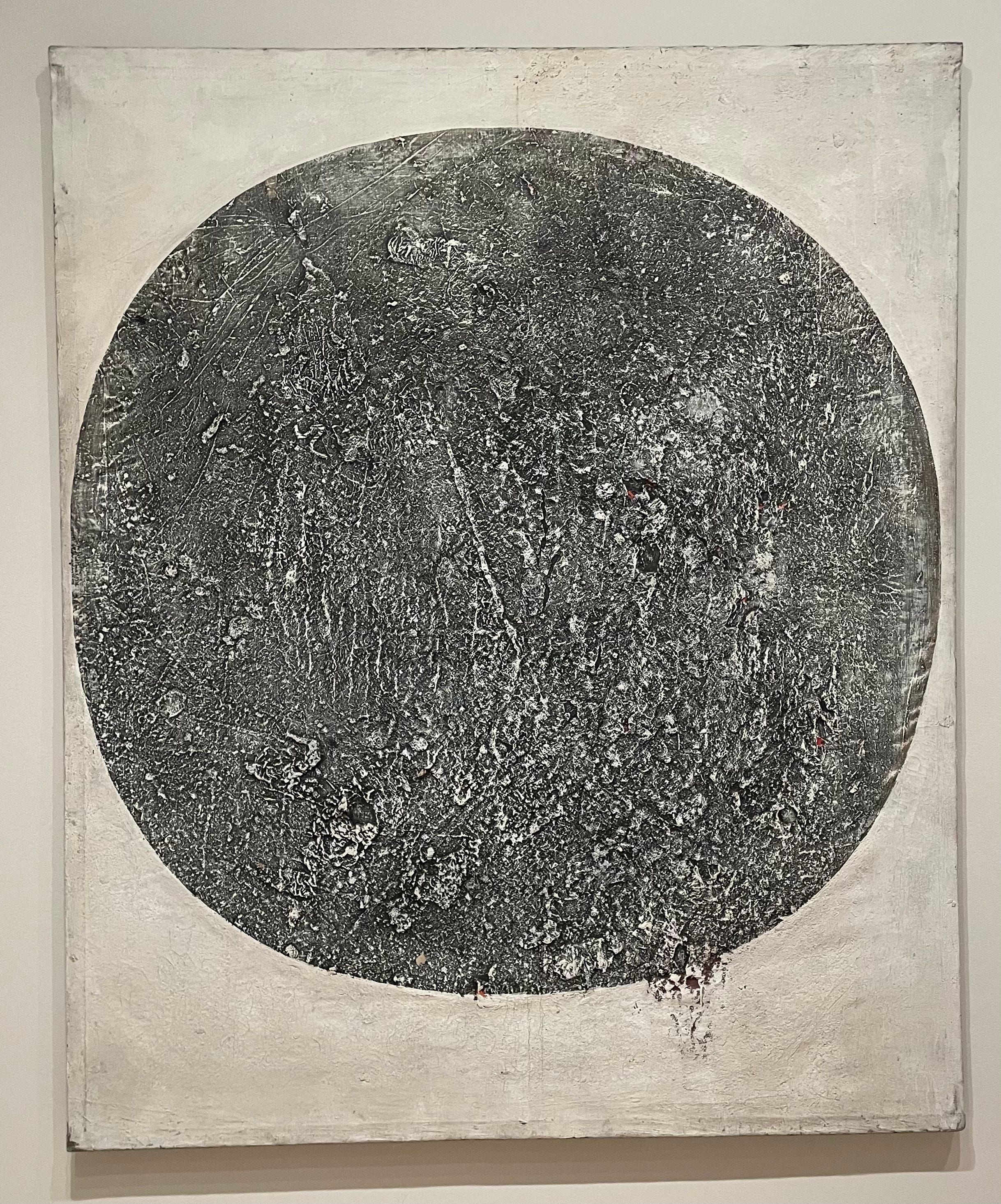
6. GUANO-ROUND, JUDIT REIGL (1964)
ANOTHER MOON!
This painting started out as an abandoned canvas Judit used to stand on while she worked for six years on a series of paintings.
It was an afterthought: it was GARBAGE.
The GUANO of the title is because she used the SHIT that fell on the floor to fertilize a brand NEW work; — she literally stood on this painting for years.
She started her career as a surrealist so she learned to value accidents; accident is a VITAL part of creation :
When U really tapped in, the world will give U as much as U give it :
U MUST NOT BE AFRAID TO UTILIZE UR EXCREMENT.
I’d never seen this painting in my life; it was aptly in the room with the Pollocks, and compared to his color-splotching, Judit’s textured abyss magnetized me;
the tree-stump/moon/planet pushing at the white space like a tumor brings to mind the outer panel of the Garden of Earthly Delights :
a hole of pure malleable potential, a world yet-to-be; but also, —
Judit Reigl fled the Soviet Union’s oppressive regime in Hungary; this planet might already be abandoned, the world desiccated & barren, — :
like in Bosch’s painting, Eden is on the inside,
all the exile has left : fading memory of a collapsing world, evinced by the red matter falling away in the bottom right, like blood from Christ’s side.
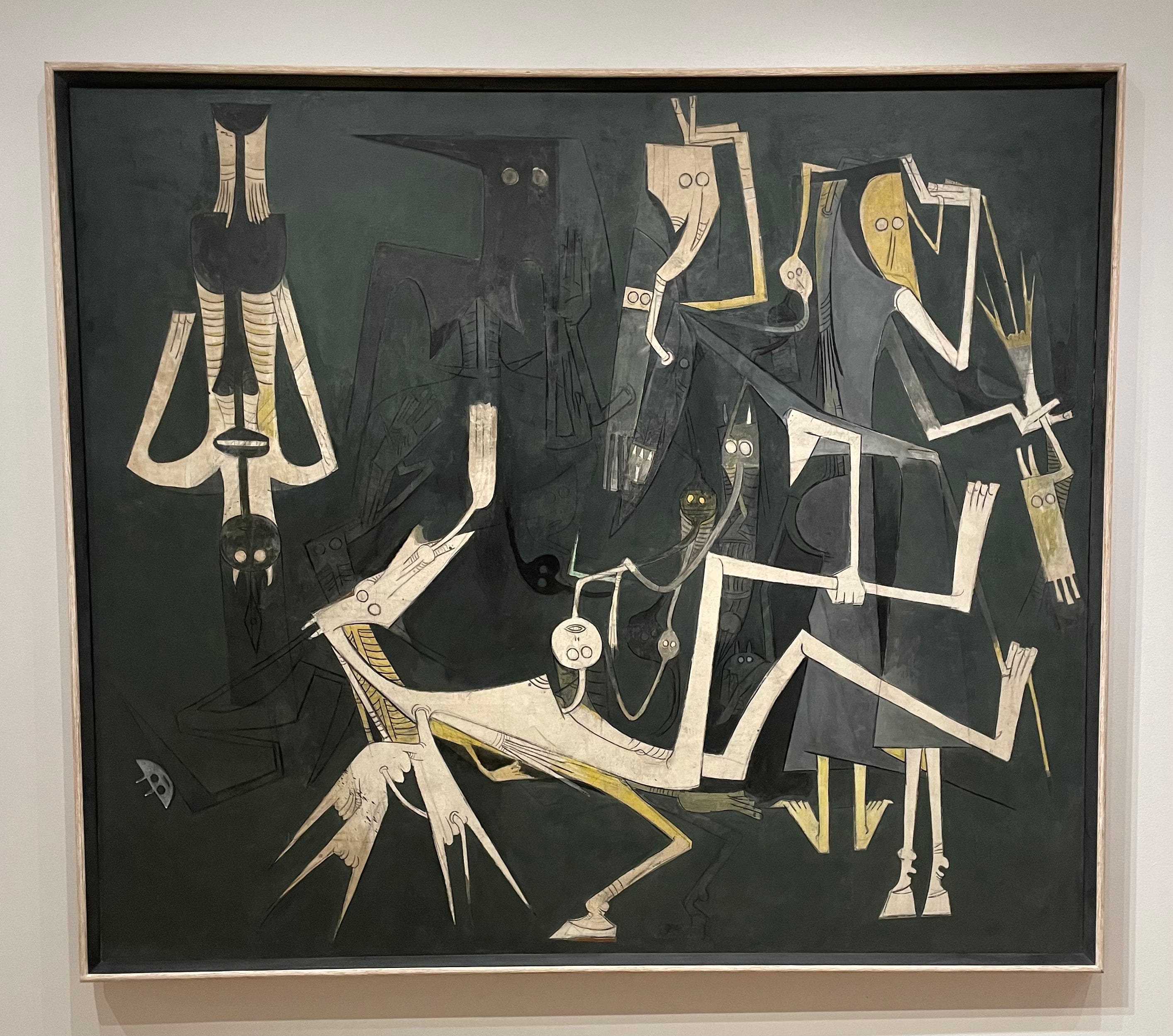
5. THE ABALOCHAS DANCE FOR DHAMBALA, THE GOD OF UNITY, WILFREDO LAM (1970)
MUSEUM-GOING IS A PHYSICAL EXPERIENCE.
Shit wears you out, walking around, looking, trying to be smart about stuff; especially if you ain’t up on where-everything-is;
it’s like reading a difficult book: the second time is always better because you got the lay of the land.
I was trying to find my way out of the museum : I was sweating, hungry, weary, eager to defecate at home : — full-on baby-mode, — when I chanced upon the Wilfredo Lam career retrospective, When I Don’t Sleep, I Dream, on the third floor.
Whenever I see a temporary exhibition my first reaction is always a hard eye-roll and then I think: “what kinda DEI bullshit are they trying to shove down our throat now?”
And yes, a myopic misanthrope could describe Wilfredo Lam as DEI bullshit : he is a mestizating Cuban painter of Chinese & African descent;
but one often overlooks the fact that unique sociology makes for unique work,
and the more widespread influences you can MIX into your work, the better it will be : Picasso (Wilfredo’s biggest European influence) knew this and he stole exotically;
but it’s always better when you got a real HOMETOWN connection to hew back to;
Wilfredo knew & learned from just about every important 20th Century artist, he went everywhere, but he was always harkening back to the Chinese & afro-latino mythology he was reared in. . .
I gotta go back and look at the whole thing with some calma, but I loved the final full-sized canvas he made;
these figures look like mischievous death-demons that were lurking just out of sight in Guernica (1937), laughing at our human tragedy.
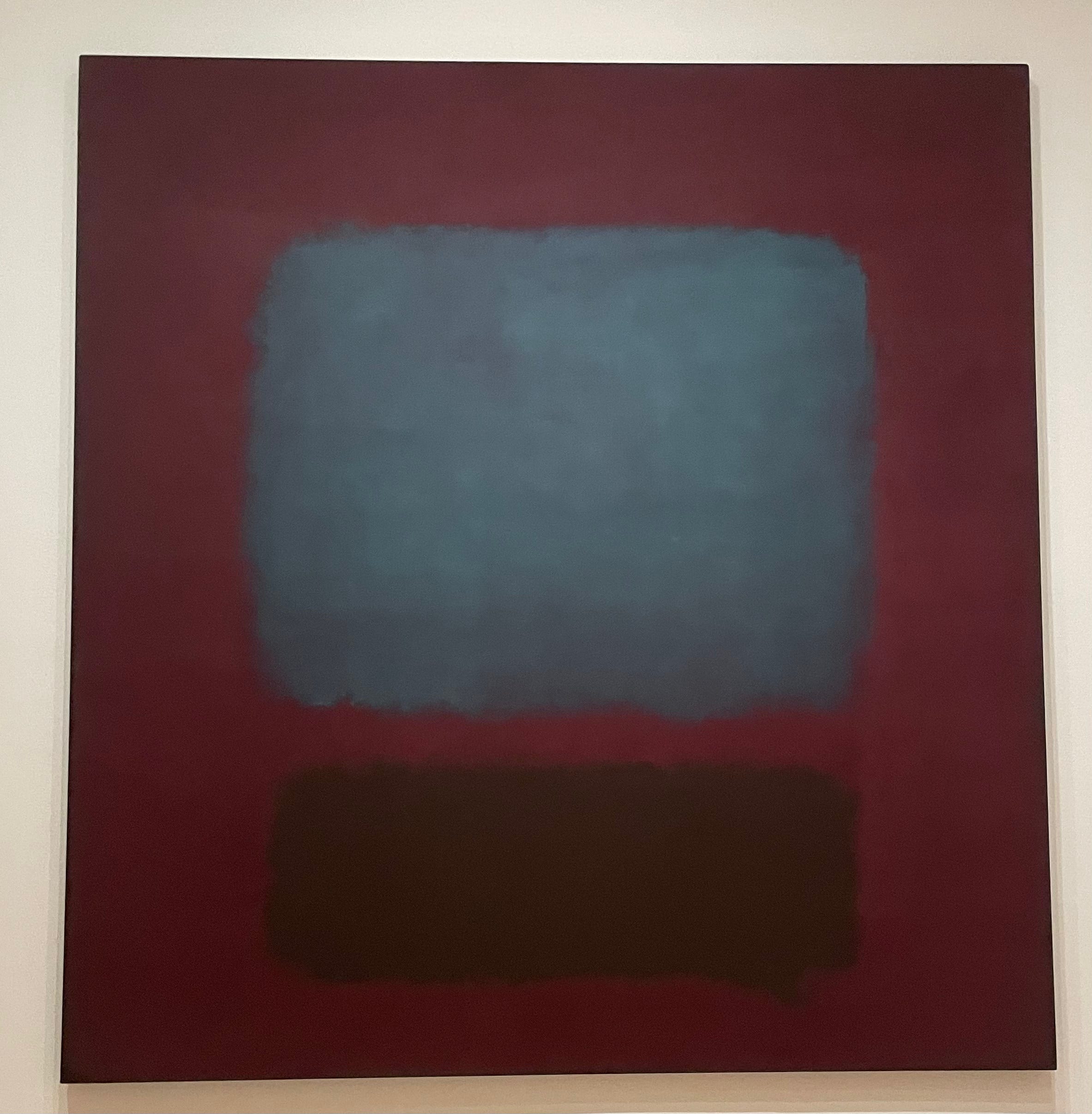
4. NO.37/NO.19 (SLATE BLUE AND BROWN ON PLUM), MARK ROTHKO (1958)
I USED TO THINK ROTHKO WAS BULLSHIT.
I had an acquaintance in college; — in my memory he’s wearing Elizabethan puffy breeches, toms, and a beret, but he can’t be, right?, —
and we went to Cincinatti Art Museum along with some other numbnutses; there’s a Rothko there, and he said that he once cried in front of that Rothko.
My eyes rolled so hard out of my head I had to call back the next day to see if they were in the Lost & Found.
I do think my pantaloon-clad colleague was being performative when he said that, but I understand it now; Rothko’s final iteration was an art of pure Space that, like Heaven or Hell, removes Time in order to achieve TRANSCENDENCE,
— much like Richard Serra, but unlike Serra, Rothko’s deity is COLOR;
his paintbrush is a machete, chopping thru the tangled jungle of interpretation to give the looker an unmediated experience of emotion.
When I look at Slate Blue and Brown on Plum, I feel that the plum is a rich sadness and the slate blue is a cloud of productive melancholy:
this is a consciousness that still finds its weariness with the world transformable into moments of joy.
What I like most about Rothko is that he argues convincingly that painting is about COLOR, and I don’t know what I feel, but these colors are fantastic.
And then right next to it, on the other side of the wall, is the most terrifying painting in the entire MoMA. Part of Rothko’s untitled final series working with black & grey, before he committed suicide.
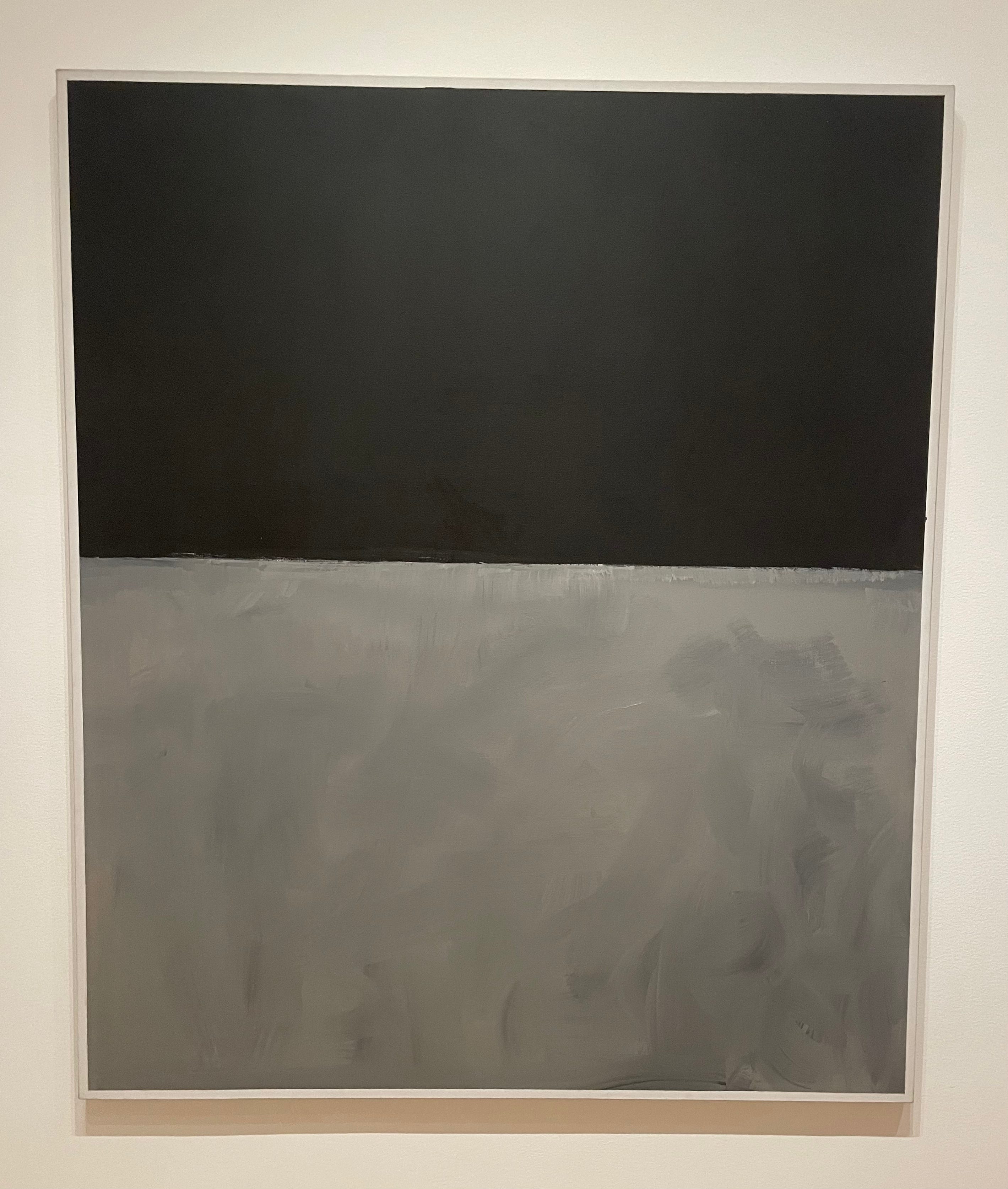
It is one of the grizzliest visions of Hell in all of Western art.
Once your God abandons you, you won’t even have the consolation of devils sticking pitchforks up your ass; all that’s left is. . .
NOTHING.
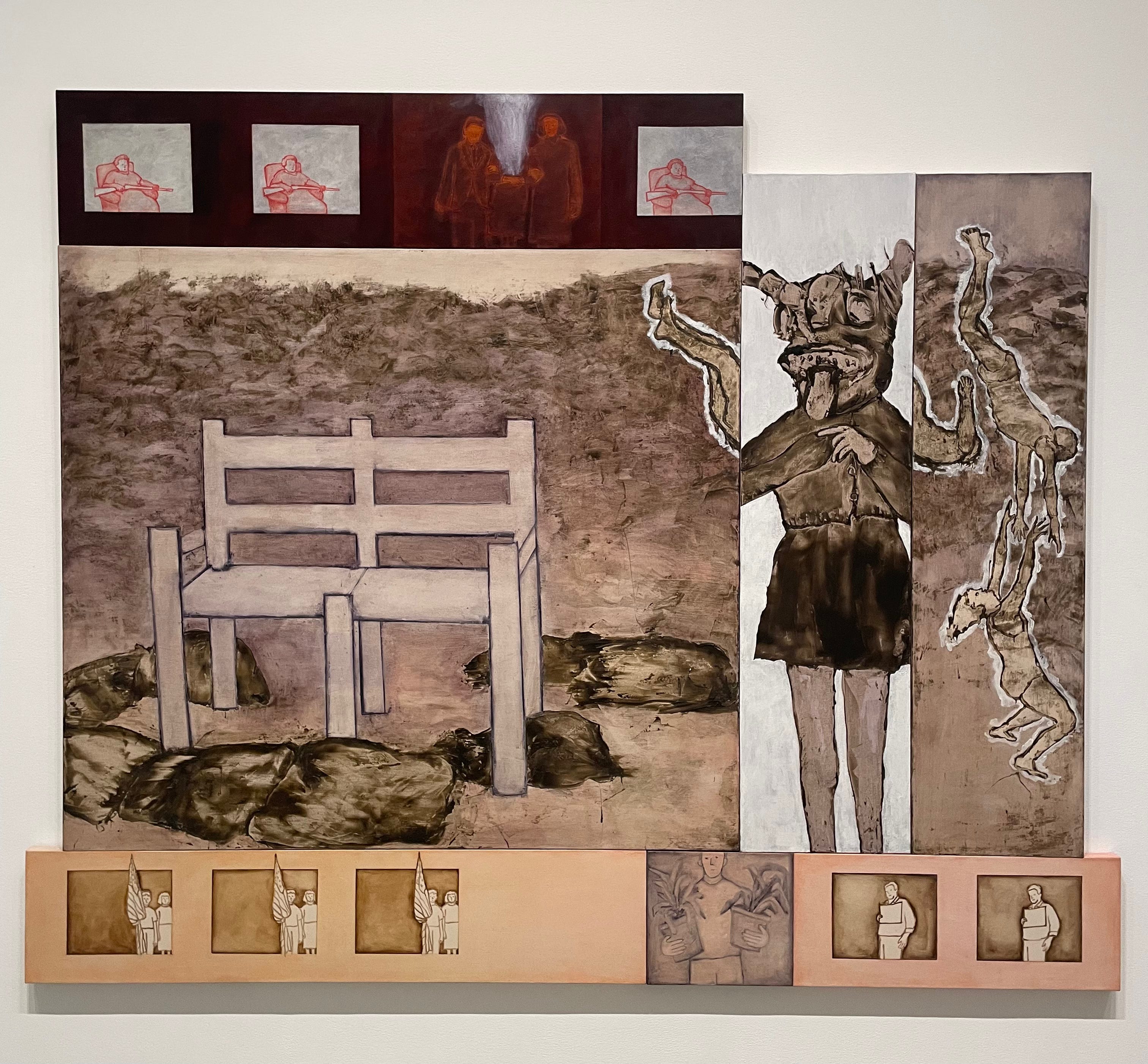
3. CHRONIC HOLLOW, IDA APPLEBROOG (1989)
THE MOST AMERICAN PAINTING AT MOMA.
MoMA don’t know what they got with this one : they tuck it away in a room you only find by accident : walled with two irrelevant mediocrities.
They should hang it next to Jasper John’s Flag (1955) so we can see Chronic Hollow in a helpful context :
— Ida Applebroog’s painting is a story about the United States.
There’s a two minute audio clip of Ida talking about this painting; she says,
“I’ve been asked very many times, why is your work always so involved with violence? And my answer is always: it’s not me that’s involved with violence, it’s the world that’s involved with violence.”4
This painting is a post-modern altar piece; six canvases are fitted together like panels and the story is told thru layered symbols & icons, — where is the violence?
Ida gives us another enlightening clue :
( — many artists in the obscurity game are reticent to divulge their occluded secrets, but sometimes popping your head out of reconditeville to drop a little hint enriches interpretation welcomefully, — )
the empty chair is the electric chair used to execute Julius & Ethel Rosenberg in 1953 : the only American citizens that were executed for espionage in peace time5;
like Wilfredo Lam, Applebroog is taking her provincial patrimony : what happened to New York Jews like her and applying it UNIVERSALLY.
There is a chronic hollow at the heart of American life :
YOU could next be the victim of this country’s violence;
most of the figures in the painting (including the chair) are placid, patient, but it is a threatening stasis like they’re lying in ambush.
One day you could be stolid, patriotic, like the two kids at the bottom holding the Flag and then the United-Staesian demon will burst thru the frame, tongue out, ridiculing,
and plunk your ass right in the electric chair.
Go LOOK at this painting : it’s fucking SICK.
2. THE RED STUDIO, HENRI MATISSE (1911)
THE AVANT-GARDE AS JOY!
Henri Matisse was in a unique position, jostling with Picasso for the princeps of the vanguard; Matisse was the BEAST, shocking lookers with his barbaric forms & OD/D colors.
Here’s what Gertrude Stein wrote about him,
“Everyone could come to be certain that he was a great man. Any one could come to be certain that he was clearly expressing something. Some certainly were wanting to be needing to be doing what he was doing, that is clearly expressing something.”
Matisse was clearly expressing something and everybody was trying to get on that wave; when Picasso (who kept a painting of Matisse’s in his studio, an honor he didn’t grant to any other contemporary) painted Les Demoiselles d’Avignon,
Matisse thought he was making fun of him; Picasso usurped him as the bestial, savage enfant terrible; —
in Gertrude Stein’s word-portrait she writes of Matisse going from “expressing something being struggling” to “not expressing something being struggling” ,
— cubism, fauvism are aversive struggly styles that wanna knock you on your ass with a jolt;
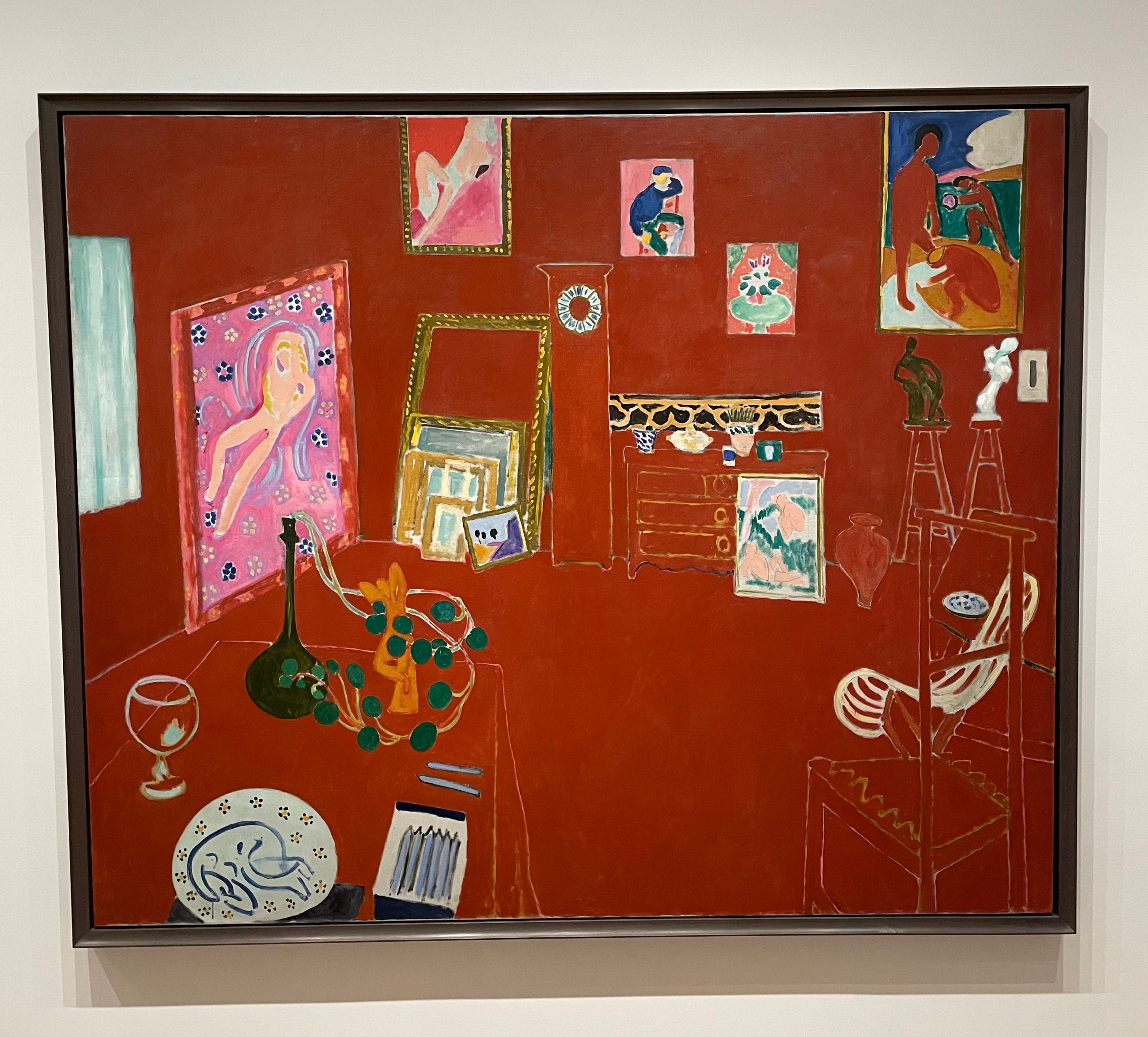
it’s telling that a few years after Picasso inaugurated cubism, Matisse paints The Red Studio :
a work that uses BOLDNESS, that outrageous RED, to WELCOME you, rather than repulse you;
this painting is funny & inviting, there’s nothing confrontational about it;
the RED is the demonic fervor of creation, enflaming his whole work space, but the energy is NOT repellant : it’s playful, makes you want to sit and watch Matisse paint for hours.
This is my #2 because it is a reminder of an important lesson, when you’re trying to push boundaries : sometimes scaring people is FUN,
but what’s even better is inviting them in & allowing them to participate in your JOY.
1. GIFTSHOP; PEEPING, HALD GROORSER (2025)
HALD GROORSER IS THE GREATEST LIVING ARTIST.
What’s fucked is you probably ain’t even heard of this dude; he’s an artist-terrorist in the Banksy lineage. . .
He sneaks into MoMA & surreptitiously hangs these HUGE canvases,
all in the same style; they’re hyperrealistic oil paintings made to look like they were pictures taken with an iPhone;
I first encountered him last year when I saw his BIG ASS PAINTING,
EAT DUH RICH (2024)
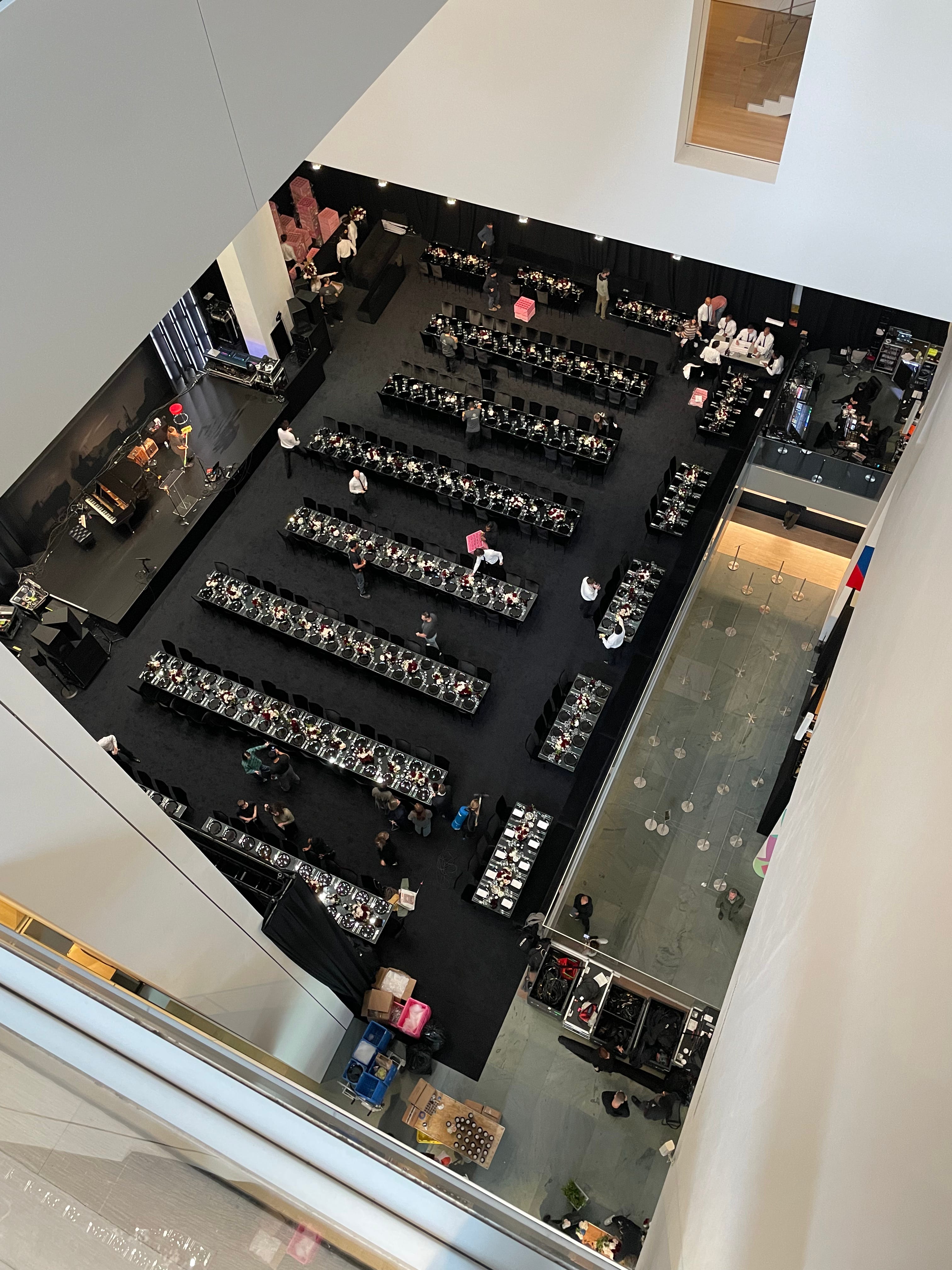
Which is a painting depicting preparations for a lavish banquet inside MoMA itself! and I saw it enormous on the wall of this lonely room off the straight path, and there was a hooded figure standing next to the painting;
I said, “oh my goodness, what is this?”
I looked at their face; they were balaclava’d.
They told me, “it’s HALD. Nobody knows who he is. He sneaks into the museum — ”
that’s when I heard, “HEY!” it was security down the hall pointing, sprinting toward the person next to me; — they vanished in a cloud of hurry ;
another security guard told me, “you can’t be here asshole!” and then proceeded to try to remove the massive painting, tottering under its unnameable heft.
I’ve been on the lookout ever since. So obviously, I was euphoric when I was trying to exit the museum and ended up getting lost and I encountered this monster :
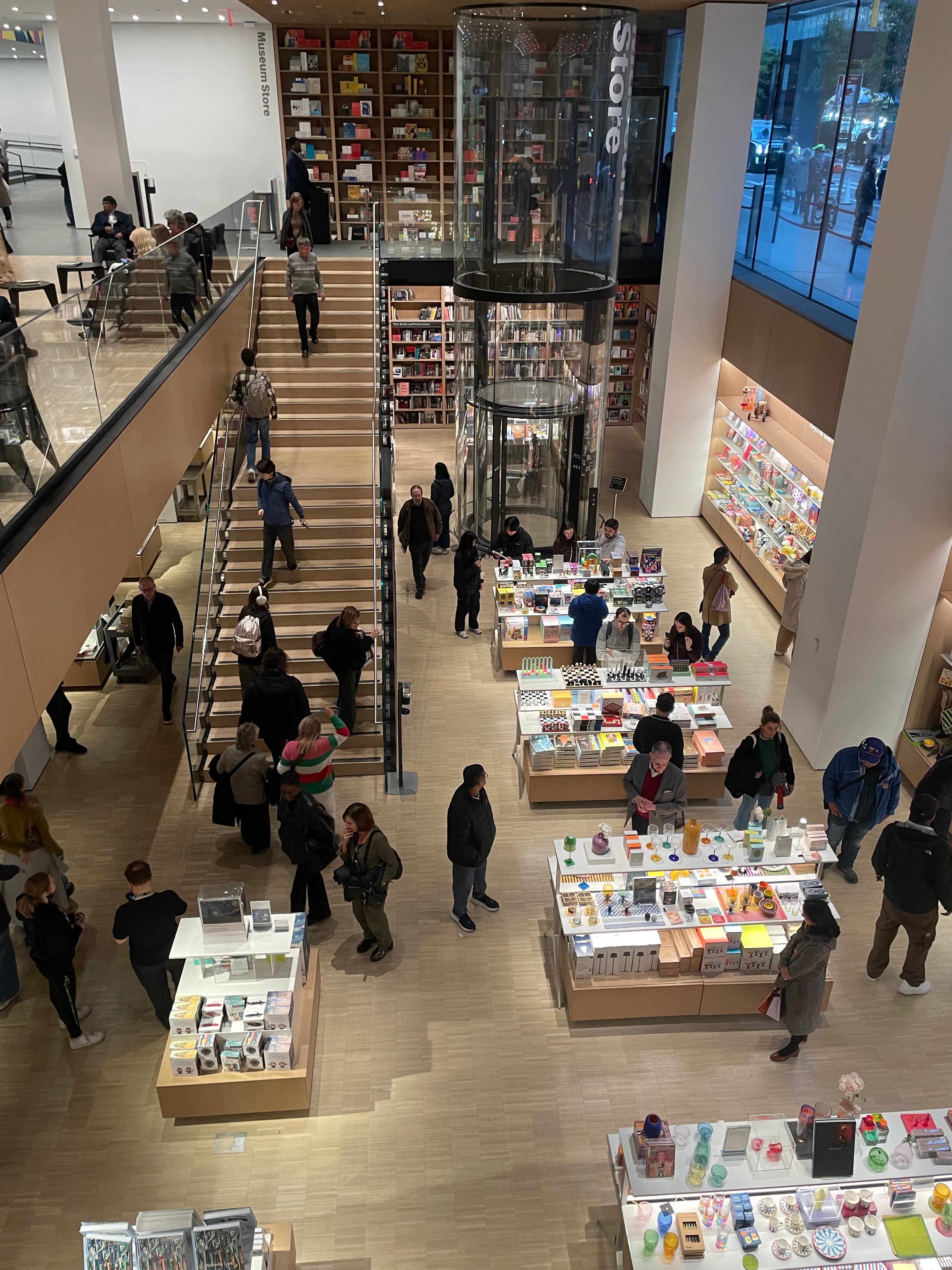
And there was a little slab of cardboard taped to the ground in front of it that read :
GIFTSHOP; PEEPING.
HALD’s innovation is turning the painter’s gaze within the painting into a judgmental one; these are subjects being watched by their GOD;
look at these drab, lethargic figures : Bruegel’s peasants without the felicity; Bosch’s hell without the extravagant punishments; it looks like any dreary regular day.
HALD is a scathing critic of our culture that churns ART into commerce;
but the fact that he is making these gargantuan canvases that always end up destroyed and in the garbage;
the fact he’s risking his freedom to hang them up in this museum, tells me that he believes in something. . .
HALD HAS HOPE!
PLZ COMMENT:
TELL ME SMTHG ABT ART! WHAT’S UR FAV MOMA WORK!?
A sanitation worker; not a guy covered in garbage.
At least, I think! I always hear smart people in the know drop the article.
I use my expired Columbia Student ID from when I did my MFA there (‘19-’21), some assholes give me a hard time about it and I tell them I’m an absent-minded PhD student who hasn’t gotten his ID renewed.
And they say, to-stumply, “Oh yeah? PhD in what?” and I say, “ohh just comp lit, yeah it’s no biggie I’m just studying the Brasilian exclusion from the Latin American boom” and I give them a lecture on Brasilian literature until they’re begging me to go inside.
Julius probably was a spy for the Soviet Union, but his wife Ethel was almost certainly innocent.
Hald Groorser’s most slept-on work, IMHO, has got to be FUPA (2019), a hyperreal oil simulacrum of an iPhone photo of Mother’s Day Brunch Service at the Dallas Museum of Art
I am skeptical of the existence of Hald Groorser. I would prefer if you would refrain from duping your readers.